Ethics and autism: The universality of Aristotle’s theory of moral responsibility
In the realm of deontological (1) ethics lies an infamous theory of moral agency: Aristotle’s theory of moral responsibility states that one’s behavioral and affective dispositions establish one’s moral character, which in turn governs one’s moral agency (Timpe, n.d.). I intend to explore the soundness and universality of the conditions of Aristotle’s theory of moral responsibility using a comparison to Socrates’ theory and, primarily, a case study of autism.
1.0 Moral responsibility
Moral responsibility regards the conditions in which a person, hereafter referred to as an agent, merits praise or reward, blame or punishment, for an action. An agent merits these attitudes for an action if and only if the agent is responsible for it. Therefore, on this attenuated interpretation, moral responsibility is a correlation between the agent and the agent’s actions (Meyer, 1993, pp. 17-18).
1.1 Moral versus nonmoral character
One’s character is made up of many kinds of traits such as physical, psychological, and social traits. While the traits as individual categories may not be of moral nature, they collectively have the capacity to influence one’s moral character, but a distinction must be drawn between those traits that are morally relevant and those that are not—between uses of the term “character trait” in reference to personality versus morality; the major difference between personality character traits and moral character traits is that moral character traits involve normative judgement, that is, they require a dimension of evaluation where one is morally responsible for the trait (Timpe, n.d.).
1.2 Aristotle’s theory of moral responsibility
Moral responsibility is generally applied to normal adult human beings. In cases of children and those who are mentally insane, we may impose reward and praise or blame and punishment with the intention of altering or establishing control over their behavior with the expectation that they will either become morally responsible agents, or have begun to assume some moral responsibility, rather than based on their deserving such treatment. The extent to which we do not believe such agents to be morally responsible, we assume objectivity—or as philosopher Peter Strawson refers to it as an objective attitude—while withholding our reactive attitudes. Strawson states that the objective attitude is “emotionally toned”, that is to say, that the reactive attitudes that involve participation in interpersonal relationships or reciprocity are subdued (Meyer, 1993, pp. 18-19). Strawson believed:
If your attitude toward someone is wholly objective, then though you may fight with him, you cannot quarrel with him, and though you may talk to him, even negotiate with him, you cannot reason with him. You can at most pretend to quarrel, or to reason, with him. (Strawson, 1962)
The characteristics that make one morally responsible are fundamental to our conception of what is most valuable in one’s life. Identifying the criteria for being a morally responsible agent is the first priority of exploring a theory of moral responsibility. These criteria define why normal adults hold themselves accountable for their actions versus why they do so only to a minimal degree with children and not at all with non-humans (i.e., animals). Subsequently, once it is defined what makes a moral agent, the next priority is to identify the criteria by which actions are considered moral or nonmoral (Meyer, 1993, p. 19).
1.2A Virtue and vice of character
Aristotle differentiated human excellence (i.e. aretē, virtue) into two categories: virtue of character (i.e. ethical virtue) and virtue of intellect. An example of virtue and vice of character would be courage and cowardice; these virtuous or vicious actions are motivated by an impersonal standard of value that was defined by Aristotle as the kalon (i.e. noble, admirable) and its opposite, the aischron (i.e. base, shameful). The appeal of the impersonal standard of value in judging one’s behavior as either kalon or aischron, coupled with the expectation of just treatment, gives justifiable reason that attributing a virtue or vice of character to an agent is to subject the agent to the precepts of morality (Meyer, 1993, pp. 19-20).
Aristotle believes virtue is defined by three qualities: passions, capacities, and states. Aristotle generalizes passions as what pain and pleasure accompany—for example, confidence, fear, appetite, envy, delight, pity, yearning. Capacities are the susceptibilities to those passions (e.g., according to which one is able to pity or be angry). States are the degree to which one is disposed to those passions (i.e., well or badly disposed; if one is disposed to anger in a violent way, they are badly disposed). Further, Aristotle defines the virtues and vices of character as the states or dispositions that dictate the time and focus of one’s passions. As an example, the virtue or vice of character regarding anger determines what an agent might envy, and the strength of envy. Once a passion is acquired, the agent, Aristotle claims, is responsible for the capacity of the passion and the way in which the passion is exercised. Meyer refers to these capacities as “feeling and doing” (Meyer, 1993, p. 22).
Aristotle knowingly excludes non-humans and the mentally insane from the deservingness of virtues and vices of character. While Aristotle acknowledges these agents may have dispositions of which they exercise their capacity to feel and do, he argues that because they lack the ability to act according to reason, a state Aristotle calls hexis prohairetikē, their dispositions could not be genuine virtues and vices of character (Meyer, 1993, pp. 22-24).
1.2B Rational desire, rational action, and happiness
Following Plato’s lead, Aristotle believes in a single rational desire of which he calls boulèsis, meaning wish. Aristotle differentiates between decision and wish, claiming that decision was the most important desire of all when considering virtue and vice of character (Meyer, 1993, p. 24). First, let us consider what makes a rational desire.
Aristotle defines a rational desire to be any desire aimed at the good (to agathon). The “good” here is happiness, or eudaimonia, which he claimed to be the greatest good for humankind, “for it includes all the goods worth pursuing for their own sake” (Meyer, 1993, p. 25). Rational actions, then, are what one fulfills in pursuit of this happiness; rational desires, in turn, are objects one pursues in expectation of happiness. The distinction Aristotle makes between these two desires is that boulèsis (i.e., wish) is relative to a goal, whereas prohairesis (i.e., decision) is similar to the things motivating one toward a said goal (Meyer, 1993, p. 25). He states:
Decision is deliberative desire for something that is up to us. Having arrived at a judgment on the basis of deliberation, we desire according to wish (As cited in Meyer, 1993, p. 25).
Thus, a decision is one’s desire to carry out actions in pursuit of happiness as demonstrated in one’s wishes.
Above the capacity to conceive happiness and the ability to form desires about happiness, Aristotle believed that the most profound quality of moral agency was one’s disposition to perform according to the conception of happiness. By an agent’s feeling or doing, the agent is expressing their conception of happiness; that is, they are acting for the sake of their happiness. This priority placed on the pursuit of happiness may strike the modern-day human as selfish or possibly anti-ethical, but Aristotle clarifies that it is not the motivation to pursue happiness that makes one moral; it is that the agent is no more virtuous than vicious in one’s hexis prohairetikē. Aristotle argues that activity can be neither moral nor immoral unless it stems from a nature that demonstrates an agent’s understanding of the pursuit of happiness. Additionally, he asserts that the pursuit of happiness is a unique characteristic of moral responsibility, hence exposing an agent to the judgment and demands of morality (Meyer, 1993, p. 26).
In his argument that the pursuit of happiness is good for oneself, Aristotle elaborates that this pursuit is not in the likeness of self-interest: “The virtuous person considers virtuous activity to be constituent of his happiness, which is to say that he performs the virtuous activity for its own sake” (Meyer, 1993, p. 27). In fact, Aristotle believes an agent should violate their own self-interest in some situations—take, for example, the virtue of courage: if an agent were faced with death where the kalon (i.e., noble) would be to submit to death and the aischron (shameful) would be not to submit to death, the virtuous agent would sacrifice their self-interest. The agent who chooses this virtuous action for the sake of virtue, therefore, is acting for the sake of their happiness (Meyer, 1993, p. 27).
1.2C Moral character
In the eyes of Aristotle, what makes a human life worth living is one’s responsibility. An agent’s commitment to acting according to reason—thus defining the agent’s virtuous or vicious character—will afford happiness:
First of all he knows what he is doing. Second he decides to do it, and decides to do it for its own sake. And third, he acts from a stable and unchangeable disposition. (As cited in Meyer, 1993, p. 28)
Aristotle’s three conditions—while he notes they are quite effortful—define the full virtue of one’s character. He was adamant that while rarely achieved, agents who make the attempt and fall short are still praiseworthy and blameworthy for their actions. An agent can fall short in various ways simply by mistaking happiness—for example, mistaking happiness for material goods or wealth. Still, this agent would be subject to moral evaluation as they acted according to reason, according to their conception of happiness, be it misguided. (Meyer, 1993, pp. 28-29).
It is important to note that Aristotle views virtues and vices of character as states of the soul, similar to how one’s health and strength are states of one’s body. In the same relation, one’s character is subject to change based on the activities one engages in, just as one’s health or strength is subject to change based on one’s activities. On this note, Aristotle believes that “some states of moral character just like some states of the body are incurable; he does not think that all states of moral character need be” (Meyer, 1993, p. 30).
In summary, Aristotle believes one’s moral character—that is, the behavior of all beings, both human and nonhuman, that is virtuous or vicious—is the result of their dispositions (i.e., one’s nature, state, hexeis). This nature of being determines the agent’s range of feeling and doing, that is, motivating and acting, in any particular situation. What distinguishes morally responsible agents from others is that this state of moral character influences the agent to act and react in a way that directly expresses their conception of happiness.
1.2D Voluntariness
Aristotle believes that the human being is the origin of action, or archē; in speaking of these actions, he states:
Those that are voluntary and those that are according to his decision are ones he is responsible for, while he is not responsible for involuntary ones. (As cited in Meyer, 1993, p.37)
Aristotle claims there are four kinds of aitia, or cause, that an agent is responsible for. The first is that “from which something comes to be but which remains” (As cited in Meyer, 1993, p.37), meaning simply, for example, the seed is the cause of a tree or the brick is the cause of a building. The second is of essence; for example, the cause of an octave is a ratio of two, three, four (and so on) to one. The third cause can be most easily recognized by modern society and is often referred to as the “efficiency cause”—it is where the advisor is the cause; in Aristotle’s example, “the father is of the child and in general the maker of the thing made, and the changer of the thing changed” (As cited in Meyer, 1993, p.37). Lastly, a cause can be for the sake of a goal. Aristotle uses these causations to extract the conditions of which an agent is informally, or as Aristotle calls it, causally responsible for their actions (Meyer, 1993, pp. 36-39).
Aristotle was intrigued with causal responsibility because of praise and blame—“we praise and blame people only for what they are responsible for” (Meyer, 1993, p. 39). As you may recall, moral responsibility regards the conditions in which an agent merits praise or blame for an action. Thus, voluntariness relates to the virtues and vices of character—that is, the dispositions that motivate one to perform actions that are subject to moral evaluation—in that voluntariness is also a condition that subjects an agent to praise or blame. Aristotle suggests that his investigation into voluntariness exposes that if virtue is praiseworthy and vice is blameworthy, they, therefore, must both be voluntary (Meyer, 1993, pp. 43-44):
So it seems to be up to us to be good and bad. Further evidence of this comes from praise and blame; for praise is for virtue, and blame for vice, but praise and blame are not for involuntary things. So it is clear that it is up to us in the same way to do good things and bad things. (As cited in Meyer, 1993, p. 41).
It is important to note here that Aristotle does not claim one is responsible for one’s states of character. Instead, he loosely concludes that “virtue and vice concern those actions for which one is oneself responsible and the origin” (As cited in Meyer, 1993, p. 43); he professes that virtue is praiseworthy not because of the actions or feelings that produce it, but because of the actions or feelings it produces, affirming that it is the action, not the state, for which one is responsible—the voluntariness Aristotle insists is required for praise and blame of one’s state of character is not a quality of acquiring these states, but the action that originates from these states (Meyer, 1993, pp. 45-48). As Meyer explains further:
Aristotle requires us to be responsible for our praiseworthy actions and feelings but not for our praiseworthy states of character, because he thinks these two sorts of items are praiseworthy in different ways. The latter are praiseworthy because they produce good actions and feelings, while the former are praiseworthy because they are the good products produced by praiseworthy states. (Meyer, 1993, p. 49)
Here, Meyer articulates Aristotle’s insistence that praiseworthiness is a product of virtue, that is, a product of one’s state of good character:
States are praiseworthy if they produce good actions and feelings; agents are praiseworthy if their states produce good actions and feelings; and the feelings and actions produced by a state are praiseworthy if they are good. While many different things are praiseworthy, they are all praiseworthy because of their relation to one fundamentally and non-derivatively praiseworthy thing: a praiseworthy state of character. This is why Aristotle repeatedly insists that all praise is given “according to virtue” or “according to the state”. (Meyer, 1993, pp. 49-50).
Aristotle’s account of voluntariness encapsulates the conditions of praiseworthiness and blameworthiness, the conditions being those of which an agent is responsible for certain good or bad feelings and actions. This praise or blame, then, is based on an evaluation of whether or not the actions and feelings were caused by the agent’s character. These essentially are moral attitudes in that they evaluate the agent’s state of character, thus becoming moral properties of the agent. Further, his account of virtues and vices of character defined the conditions to be met for an agent to be subject to moral evaluation. While children, nonhuman animals, and mentally insane are all voluntary agents, he does not believe they are responsible for their voluntary actions, “only agents who have a moral character”—that is, the state of character that influences the agent to act and react in a way that directly expresses their conception of happiness—“are morally responsible for their voluntary actions” (Meyer, 1993, p. 52).
In defining voluntariness, it is also important to address involuntariness and the conditions of which an agent is not causally responsible for involuntary actions. In Eudemian Ethics, Aristotle provides two conditions required of involuntariness: a) the action is externally caused or due to ignorance of facts, or b) the agent feels regret or pain for the action. Here, Aristotle is suggesting that attitudes such as pity or forgiveness are explicitly attributed to involuntariness (Meyer, 1993. pp. 82-83).
1.2E Compulsion and accidental action
Aristotle claimed there were different types of influences on actions. In contrast to desire, Aristotle names anankē (i.e. compulsion) and bia (i.e. force). These two influences are similar in that they influence an agent to take an action that they do not want to. However, genuine force, Aristotle asserts, is influenced by an external agent, whereas a compulsion originates from within. Between these two types of action—force and compulsion—Aristotle maintained only one to be voluntary: compulsion (Meyer, 1993, p. 97).
It must be clarified that not all compulsions, however, are blameworthy. Take this extreme situation for an original example:
You are the chief officer on the scene of a hostage situation. The captor has a gun to the head of a hostage outside of an office building of which he has barricaded a remaining 200 people. The captor is also wearing an explosive belt that will detonate in five minutes if his demands are not met. You have a bomb squad on the scene who can deactivate the explosive belt, however, the captor says if anyone approaches him, he will kill the hostage. A sniper on the scene has only one shot he can take, but at this angle, it is possible that the bullet could pass through the captor and hit the hostage, potentially killing them both. If he takes this shot, though, the bomb squad can deactivate the explosive belt saving the remaining 200 people in the building. You, the chief officer, know that both options are not desirable, but one is less desirable than the other—the other, of which, could kill 2, but save 200.
In this situation, if you are compelled to choose the option to have your sniper take out the captor, risking the life of one hostage, you, in the eyes of Aristotle, would be praiseworthy, even if your action was bad or unjust, simply because you averted a less terrible consequence. If you chose not to have your sniper take the shot and the captor’s explosive belt detonated, killing the captor, his immediate hostage, and the remaining 200 hostages in the building, Aristotle would maintain that you are still responsible for your action, which in this case would be blameworthy as the consequence is the worst of the two actions you could have taken.
The example above would demonstrate what Meyer calls “rational compulsion”. Rational compulsion is where an agent performs a particular action because it is the “lesser of two evils”. Separately, a psychological compulsion would be where the alternative of a compelled action is either so painful or insupportable that the agent is unable to avoid taking an action (e.g., if one was being tortured for information and divulged secrets). Aristotle invokes two conditions to be met to be considered a compulsion: the agent must be compelled to do “something bad for the sake of something good, or in order to avoid a greater evil” (As cited in Meyer, 1993, p.98). The supplemental condition to be met for an action to be considered a psychological compulsion would be that the alternative to the compelled action would be sufficiently more painful (Meyer, 1993, p. 98).
And some such actions are even praised—whenever someone submits to something shameful or painful as the price of greater and noble things. And whenever the opposite is true, they are blamed—for to put up with something exceedingly shameful in exchange for nothing fine or commensurate is the mark of a base person. (As cited in Meyer, 1993, p. 112)
Referring back to the example of the hostage situation, you, the chief officer, decided to risk the lives of 2 people to save the lives of 200, versus the greater of the two evils, risking the lives of 202, which would save none. Saving the 200 remaining hostages and bringing about the injustice of potentially killing 2 are, as Aristotle believes, only accidentally the same action—you, the compelled agent in this example, perform the former action (that is, saving the lives of 200 hostages) non-accidentally and the latter action (that is, giving the sniper the “okay” to shoot the captor, potentially injuring or killing the immediate hostage) only accidentally. This is to say that a compelled action is both voluntary and involuntary: you are subject to moral evaluation for the first decision to take the action resulting in the lesser of two evils (i.e. voluntary action), however, you are not subject to moral evaluation for having to perform an unjust action (i.e. accidental outcome); conversely, should you decide to perform the action resulting in the greater of two evils, you are morally responsible for both, as you consciously chose the action that resulted in injustice (Meyer, 1993, pp. 109-117).
1.2F Responsibility of character
Initially, it seems contradictory to Aristotle’s arguments in Eudemian Ethics, when Aristotle argues in Nicomachean Ethics that one is responsible for their state of character:
People are themselves responsible for having come to be like this, by living without restraint, and for being unjust or intemperate . . . So to be ignorant that it is from exercising particular actions that one’s states come to be is the mark of someone completely without perception . . . if someone does knowingly what will make him unjust, then he is unjust voluntarily. (As cited in Meyer, 1993, p. 122)
To understand what Aristotle means by “responsibility of character”, we must examine the stages of which one might become responsible for their state of character. According to Aristotle, there are only two stages—these two stages of habituation encapsulate nurture and care, both from outside the self and within (Meyer, 1993, pp. 123-124):
Nurture and ways of spending one’s time must be commanded by the laws, for things will not be painful once they have become ingrained in one’s character (sunēthē). But it is presumably not sufficient for people to receive proper nurture and care when they are young. Rather even once they are mature they must spend their time on them and become habituated to them. Concerning these things, and in general concerning the whole of life, we would need laws. (As cited in Meyer, 1993, p. 124)
The first of these two stages concerns governing one’s moral responsibility with the guidance of a parent, educator, or another human adult mentor. The second stage is governed by one alone in adulthood, where one continues to work on their character in the ways in which one spends their time.
A paramount perspective to clarify is that Aristotle did not assert that the adult agent who wishes to be virtuous should only partake in virtuous activities; in fact, he believed that should one do this, one might become deficient in the broad experiences of emotions associated with the virtues and vices of character. Take courage: How does one become courageous? By experiencing fearful situations. If one were always virtuous, Aristotle claims, one would never experience fearful situations. These fearful situations are how one learns, acquires, exercises, and then becomes courageous (Meyer, 1993, pp. 124-125). He instead encourages one to engage and learn:
By their activities in exchanges with people, some people become just, others unjust. By acting in dangerous situations and becoming accustomed to feel fear or confidence, some people become brave, others cowardly. And similarly with activities concerning appetites and anger: some people become temperate and gentle, others intemperate and irascible, by conducting themselves this way or that way in these situations. (As cited in Meyer, 1993, p. 125)
In sum, Aristotle contends that it is not one’s upbringing—the nurture and care received when young—alone that is an accountable foundation for one’s character; it is the sum of nurture and care received from both mature human adults in childhood, and the engagements one partakes in adulthood, that establish this state (Meyer, 1993, p. 125).
Another important point to clarify is Aristotle’s claim of the scope of one’s moral responsibility. Meyer gives the example of a “person who has had a deprived childhood or a bad upbringing or environment” who, by consequence, “will embark on a final stage of habituation with the wrong goals, but through no fault of his own” (Meyer, 1993, p. 126). How is this agent to be fully, morally responsible for their state of character as they transition into the second stage of habituation—adulthood—from a state that was clearly nurtured insufficiently? Next, then, we must explore how one maintains a qualified responsibility for their state of character.
Aristotle theorizes that having a qualified responsibility of character involves a few steps which have been laid out in the previous pages. The first step begins as such:
For in those cases in which it is up to us to do something it is also up to us not to do it, and in cases in which no is up to us, so is yes. So if doing it, which is fine, is up to us, not doing it, which is bad, is also up to us. And if not doing it, which is fine, doing it, which is shameful, is also up to us. (As cited in Meyer, 1993, p. 130)
Following Aristotle’s conclusion that both virtuous and vicious actions are up to us, he resolves that being virtuous or vicious is also up to us:
And if it so up to us to do fine actions and shameful ones, and in the same way not do them, and this is what it is to be good and bad, then it is up to us to be decent and base. (As cited in Meyer, 1993, p. 130)
By this, Aristotle means that our responsibility of character is respective—because our states of character are the origins of our actions, they are praiseworthy or blameworthy only because of their relation to the production of the voluntary virtuous or vicious actions we perform (Meyer, 1993, pp. 120-138). That is to say—in a seeming causality dilemma—we become causally responsible for our state of character by way of the actions we perform:
People are themselves responsible for having come to be like this, by living without restraint and for being unjust or intemperate. (As cited in Meyer, 1993, p. 135)
In arguing how one is responsible for one’s character, Aristotle brings about the subject of ignorance:
If someone does knowingly what’s will make him unjust, then he is unjust voluntarily. This is of course not to say that whenever he wishes he will stop being unjust and will be just, for neither will the sick person become well in this way. If he got sick in this way, he got sick voluntarily, by living incontinently and disobeying doctors. Back then, it was open to him not to be sick, but it is no longer open to him, now that he has let himself go, just as it is no longer possible for the one who has thrown the stone away to retrieve it. But all the same, it was up to him to throw it, since the origin was him. And so too, for the unjust and intemperate person, while it was open to them in the beginning not to become like this—which is why they are like this voluntarily—once they have become like this it is no longer open to them not to be like this. (As cited in Meyer, 1993, p. 138)
Additionally, Aristotle claims that an agent whose ignorance is the product of carelessness is indeed responsible for their character, as they initially had the control, that is, the voluntariness to decide to take an action, that caused the ignorance (Meyer, 1993, p. 139):
While we are in control of our states in the beginning, the progression in each case is not obvious, as in the case of infirmities. But our states are voluntary for this reason: because it was up to us to conduct ourselves in this way or not. (As cited in Meyer, 1993, p. 138)
Aristotle is not saying that our responsibility of character is unconditional, not entirely—rather, he is attesting that at a certain point, the moral education of one becomes the property of one and no longer the property of the parents, teachers, or mentors that raised one. It is up to this agent to decide which activities to perform; this is to say that Aristotle is regarding both those who were raised morally knowledgeable and those who were not, as even those who were not still have the control to decide to regard or disregard the moral directives taught to them (Meyer, 1993, p. 141).
1.2G Moral agency
Aristotle expresses that a voluntary agent is the efficient cause of one’s action, that is, the origin of change (i.e., action). Later in his works, he addressed this voluntary agent as a self-mover. As Meyer explains, a mover (i.e., agent) causes a movement by “exercising a causal power whose exercise is itself a movement” (Meyer, 1993, p. 152), and therefore “it fails to have primary causal responsibility for the movement it causes” (p. 152). This is because, according to Aristotle, “anything that is in motion must be moved by something” (As cited in Meyer, 1993, p. 152). This would mean that a moved mover causes a change by itself being moved. Aristotle solves this dilemma by claiming that the agent, that is, the mover (i.e., self-mover), is in fact “unmoved in causing its own motion” (Meyer, 1993, p. 152). In this causal status, Meyer further explains this agent-causation theory:
. . . the agent’s causation of his action cannot be analyzed into any set of events, and hence it is not due to any antecedent events. As a result, the agent’s action is due to the agent himself, and not to any antecedent event. The action’s origin is the agent precisely because the agent is a case that is not an event. (Meyer, 1993, p. 152)
In sum, the self-moving agent is, as Aristotle maintains in his justification of voluntariness, the origin of action (i.e., efficient cause), and therefore, is causally responsible for one’s actions—actions of which also subject the agent to moral evaluation (Meyer, 1993, p. 152).
So it is that the self-moving agent moves its own movement and is, in parallel, an unmoved mover. But what is this causal power? It is the skill that is used to take the action. For the self-moved mover, it is the unmoved mover. For the agent, it is the moral character. For the just person, it is justice, and for the unjust person, it is injustice (refer to Table 1.0) (Meyer, 1993, pp. 153-154). So, it is reasonable to conclude that the just agent is also a self-mover, who uses their moral character (i.e., the unmoved mover) in performing a voluntary action of justice which results in a just thing.
As we defined what the agent is and is not responsible for accidentally and non-accidentally, we need to justify what the self-mover is and is not responsible for. In causality, Aristotle provides an example of a doctor, who also happens to be a builder, who cures a patient. The doctor in this example would be the non-accidental cause of the cure, while the builder is the accidental cause. Translating this to the self-moving agent, Aristotle poses the agent’s desire as the causation of action. As Meyer summarizes:
The agent is the non-accidental cause of an unjust desire, while the external object whose perception precipitates that unjust desire is only the accidental cause of an unjust desire. (Meyer, 1993, p. 159)
As an example, a vicious person sees a wallet full of cash left on a table at a diner. The person decides to steal the wallet. This wallet is the external object that resonates within the agent, stirring the unjust desire to steal it. Meyer asks if this external object—in our case, the wallet—has the “power that, if unimpeded, will reliably produce unjust desires? Clearly not, for in itself it is no more productive of just desire than of unjust desires” (Meyer, 1993, p. 160). The wallet, then, would be an accidental cause of the unjust desire, while the agent would be the non-accidental cause of the unjust desire and unjust action that exude the unjust characteristic of the agent.
Aristotle’s discourses regarding states of character deduce that the characteristic activities of these states of character are to be classified respectively within the general headings of feeling/doing justice and feeling/doing injustice. The extent of conditions formerly presented envelop my complete understanding of Aristotle’s theory of moral responsibility (refer to Figure 1.0).
1.3 Socrates’ theory of moral responsibility
Socrates believes that truth and knowledge are fundamental to both a good life and to philosophy in moral and intellectual pursuits. His well-recognized paradox states that “virtue is knowledge and that when men do wrong, it is only because they do not know any better” (Euthyphro ix). Socrates claimed:
The aim is not to choose the right but to become the sort of person who cannot choose the wrong and who no longer has any choice in the matter. This is what he sometimes expresses as becoming like a god, for the gods. (Euthyphro x)
The theories of moral responsibility I am to gather from Socrates are presented by Plato in the form of the Socratic Method, a method of which, in this case, Plato uses a dialogue setting between Socrates and another agent to explore the conditions of Socrates’ theories (Shwartz, 2018).
1.3A The definition and acquisition of virtue
In Plato’s Meno, Socrates explores the definition of virtue and how it is acquired through a dialogue with one of the leading families in Thessaly, Meno’s. The story begins rather abruptly with Meno asking Socrates about whether virtue is taught, is acquired through practice, or is learned by some other method. First, Socrates seeks to define what virtue is. Meno defines virtue as conditions and qualities relative to their agent:
First, if you want the virtue of a man, it is easy to say that a man’s virtue consists of being able to manage public affairs and in so doing to benefit his friends and harm his enemies and to be careful that no harm comes to himself; if you want the virtue of a woman, it is not difficult to describe: she must manage the home well, preserve its possessions, and be submissive to her husband; the virtue of a child, whether male or female, is different again, and so is that of an elderly man, if you want that, or if you want that of a free man or a space . . . there is a virtue for every action and every age . . . and the same is true for our wickedness. (Meno 71e-72)
Socrates does not hesitate to call out the weakness in this perspective quite brashly, sharing that there is but one virtue, not several:
I seem to be in great luck, Meno; while I am looking for one virtue, I have found you to have a whole swarm of them. But, Meno, to follow up the image of swarms, if I were asking you what is the nature of bees, and you said they are many and of all kinds, what would you answer if I asked you: “Do you mean that they are many and varied and different from one another insofar as they are bees? Or are they no different in that regard, but in some other respect, in their beauty, for example, or their size or in some other such way?” (Meno 72-b)
Socrates is arguing here that even within the variations of virtues, there is still one form that is constant, one form that makes a virtue, a virtue. Socrates recognizes that Meno believes there are not only several relative variations of virtue, but virtues of different qualities. Socrates does not deny this, but he contests there is one overarching virtue, a virtue that encompasses all others (Meno 73d-74b):
. . . take roundness, about which I would say that it is a shape, but not simply that it is shape. I would not so speak of it because there are other shapes . . . (Meno 73e)
As their dialogue continues, Socrates points out many more weak arguments of Meno’s. Meno offers his second argument, revising that virtue is the ability to “rule over people” (Meno 73d). Socrates objects, stating that this ability is only good if it is just and justice, like courage, is a kind of a virtue, but is not virtue. Meno revises his definition a third time proposing then that “virtue is to desire good things and have the power to secure them” (77d). Socrates contests this definition as well, asking “what is virtue, if every action performed with a part of virtue is virtue?” (79c).
After failing to define virtue in four attempts, Meno admits he is confused. He then suggests that either one knows something, or one does not, however, if one does not know something:
How will you look for it, Socrates, when you do not know at all what it is? How will you aim to search for something you do not know at all? If you should meet with it, how will you know that this is the thing you did not know? (Meno 80d)
Socrates offers a complex answer:
As the soul is immortal, has been born often, and has seen all things here and in the underworld, there is nothing which it has not learned; so it is in no way surprising that it can recollect the things it knew before, both about virtue and other things. (Meno 81b-e)
Socrates demonstrates his reasoning by calling over one of Meno’s slaves. The boy is uneducated but Socrates attests that the slave can solve a geometry problem. He draws a large square in the dirt and divides it up into four quadrants. He asks the slave how to double the area of the square. The boy answers incorrectly three times, to which Socrates is quick to point out how his ignorance is similar to that of Meno’s in claiming to know something he does not. Socrates then guides the slave to the correct answer, arguing that he did know how to solve the problem; he just needed to be guided toward recalling it (Meno 82-86c).
This leads into the third part of their dialogue: determining whether or not virtue can be taught. Socrates asks, “is it teachable? Or is it plain to anyone that men cannot be taught anything but knowledge?” (Meno 87c), then suggests that “if virtue is a kind of knowledge, it is clear it could be taught” (87c). They continue their dialogue to explore this theory.
The first point of the argument resolves that “virtue is something beneficial” (Meno 87e), that is, something good to have. What, then, are good things to have? Socrates lends that “all that the soul undertakes and endures if directed by wisdom, ends in happiness, but if directed by ignorance, ends in the opposite” (88b), reconciling that:
If then virtue is something in the soul and it must be beneficial, it must be knowledge, since all the qualities of the soul are in themselves neither beneficial nor harmful, but accompanied by wisdom or folly, they become harmful or beneficial. This argument shows that virtue, being beneficial, must be a kind of wisdom. (Meno 88c-d)
Socrates’ argument concludes that virtue is beneficial; therefore, it must be a kind of wisdom—hence, it can be taught. Socrates poses an obstacle to this settlement, inquiring, “If not only virtue but anything whatever can be taught, should there not be of necessity people who teach it and people who learn it?” (Meno 89d). Socrates expresses that he has never met anyone who taught virtue. One of Socrates’ accusers, Anytus, comes to join the dialogue, sharing that he believes that “men have learned from those who were gentlemen before them” (Meno 93), that is, virtue is taught by being passed down, or shared amongst agents. Socrates, unconvinced, believes virtue is “present in those of us who may possess it as a gift from the gods” (Meno 100b).
1.3B The virtue of knowledge and truth
Unlike many of Plato’s works, which feature Socrates as a protagonist who partakes in a fictional-realistic dialogue about Socrates’ theories, Plato’s Apology claims to be an actual account of the speech given by Socrates in his defense trial. It is not to say this entire record is accurate; however, it is believed by many to be mostly truthful to the historical events of Socrates’ trial, and Plato professed his attendance at the trial. An important distinction to make before beginning my examination of the theories within Apology is that the title is a mere transliteration of the Greek word apologia, meaning defense (this is, after all, Socrates’ defense speech) (Apology, p. 21).
In the beginning of Socrates’ speech, he contends that he knows nothing; therefore, he is wiser than his prosecutors:
. . . my experience was something like this: I thought that he appeared wise to many people and especially to himself, but he was not. I then tried to show him that he thought himself wise, but that he was not. As a result he came to dislike me, and so did many bystanders. So I withdrew and thought to myself: “I am wiser than this man; it is likely that neither of us knows anything worthwhile, but he thinks he knows something he does not, whereas when I do not know, neither do I think I know; so I am likely to be wiser than he to this small extent, that I do not think I know what I do not know.” After this I approached another man, one of those thought to be wiser than he, and I thought the same thing, and so I came to be disliked both by him and by many others. (Apology 21c-e)
Socrates is alluding to the virtue of knowledge in this part of his speech; in Aristotle’s theory, Socrates would be praiseworthy in his efforts to justly criticize another man for his illusory concept of self. By Richard Taylor’s very definition of pride—that is, “the justified love of oneself, and all that justifies such love is excellence or virtuosity that is genuine” (Taylor, p. 36)—Socrates would be prideworthy in that Socrates calls himself on what he does not know, and, this self-knowledge, in turn, is in fact what makes him “superior” to others. (I would like to note, though, that a potential argument can be made against Socrates as a prideworthy man, for he is seeking the approval of a jury with his claims and calling attention to himself, which, to Taylor’s conditions of pride, is not prideworthy:
A proud man has no need to dominate, welcomes corrections, cares little about the approval of others, is soft-spoken, and does not call attention to himself. (Taylor, p. 29)
Socrates continued to approach those who were thought to be the wisest, thinking:
I thought that I must attach the greatest importance to the god’s oracle, so I must go to all those who had any reputation for knowledge to examine its meaning . . . In my investigation in the service of the god I found that those who had the highest reputation were nearly the most deficient, while those who were thought to be inferior were more knowledgeable. (Apology 21e-22)
Socrates began seeing counterfeit pride in wisdom all around him. Still, he continued his quest of justice:
So even now I continue this investigation as the god bade me—and I go around seeking out anyone, citizen or stranger, who I think wise. Then, if I do not think he is, I come to the assistance of the god and show him that he is not wise. (Apology 23b)
Socrates claims that in doing this justice on behalf of the gods, he is doing a virtuous service, which, to the unfortunate consequence, has left him in poverty. As he cross-examines Meletus, his prosecutor in this trial, he comes to a resolution about virtue and knowledge:
This is the truth of the matter, men of Athens: wherever a man has taken a position that he believes to be best, or has been placed by his commander, there he must, I think, remain and face danger, without a thought for death or anything else, rather than disgrace. (Apology 28d-e)
This part of Socrates speech closely relates to Aristotle’s theory of moral responsibility, particularly in violation of self-interest for the sake of the virtuous, that is, pursuing happiness. Aristotle believed an agent should violate their own self-interest in some situations, such as in this instance: if an agent were faced with death where the noble action to take would be to submit to death and the shameful would be not to submit to death, the virtuous agent would sacrifice their self-interest of courage. Aristotle believes that the agent who chooses this virtuous action for the sake of virtue, therefore, is acting for the sake of their happiness (Meyer, 1993, p. 27). Socrates continues:
It would have been a dreadful way to behave, men of Athens, if . . . I had, at the risk of death, like anyone else, remained at my post where those you had elected command had ordered me, and then, when the god ordered me, as I thought and believed, to live the life of a philosopher, to examine myself and others, I had abandoned my post for fear of death or anything else . . . To fear death, gentlemen, is no other than to think oneself wise when one is not, to think one knows what one does not know. No one knows whether death may not be the greatest of all blessings for a man, yet men fear it as if they knew that is the greatest of evils. And surely, it is blameworthy ignorance to believe that one knows what one does not know. (Apology 28e-29c)
Socrates continues to argue that it is in this very fact (his self-knowledge in that he does not know everything) he is wiser than those who claim to know everything (or at least, claim to know what they do not), that Socrates is justly praiseworthy, and those who claim to know what they do not are justly blameworthy.
But while Socrates knows it is wrong to disobey a superior, “be it god or man” (Apology 29b), he says that if given the opportunity to be acquitted for his crimes, he would still continue to challenge those who claim they are truthful and wise:
. . . I would say to you: “Men of Athens, I am grateful and I am your friend, but I will obey the god rather than you, and as long as I draw breath and am able, I shall not cease to practice philosophy, to exhort you and in my usual way to point out to any one of you whom I happen to meet: ‘Good Sir, you are an Athenian, a citizen of the greatest city with the greatest reputation for both wisdom and power; are you not ashamed of your eagerness to possess as much wealth, reputation, and honors as possible while you do not care nor give thought to wisdom or truth, or the best possible state of your soul?’ (Apology 29d-e)
It is in this part of Socrates’ defense we learn the true value he places on wisdom and truth as virtues. It is evident that he believes the virtuous to be those who act and pursue in truth and wisdom and the vicious to be those who do not (i.e. pursue other vanities such as wealth and power). Further, he claims he is acting virtuously on behalf of his god for continuing to act in this manner of examining those for genuine wisdom:
Then, if one of you disputes this and says he does care, I shall not let him go at once or leave him, but I shall question him, examine him, and test him, and if I do not think he has attained the goodness that he says he has, I shall reproach him because he attaches little importance to the most important things and greater importance to inferior things. I shall treat in this way anyone I happen to meet . . . Be sure that this is what the god orders me to do, and I think there is no greater blessing for the city than myself service to the god. (Apology 29e-30)
Socrates closes this point in sharing that he believes excellence is about being virtuous rather than having extravagant things, which is quite similar to Richard Taylor in his conditions of pride; Taylor claimed, “you cannot derive pride from things,” (Taylor, 1996, p. 117) and that “if you never attain [wealth], it does not matter, for you already have what is important—yourself, and the ideal of yourself that you aspire to” (p. 120). Socrates states:
For I go around doing nothing but persuading both young and old among you not to care for your body or your wealth in preference to or as strongly as for the best state of your soul, as I say to you: Wealth does not bring about excellence, but excellence makes wealth and everything else good for men, both individually and collectively. (Apology 30-b)
At the end of Socrates’ defense, the jury decides that Socrates is still guilty. When Socrates offers to pay a fine for his release, the jury reconvenes and passes a motion sentencing Socrates to death. Disappointed in the jury’s ignorance, Socrates still agrees to his fate, taking one last jab at the truth before the jury:
I was convicted because I lacked not words but boldness and shamelessness and the willingness to say to you what you would most gladly have heard from me, lamentations and tears and my saying and doing many things that I say are unworthy of me but that you are accustomed to hear from others . . . It is not difficult to avoid death, gentlemen; it is much more difficult to avoid wickedness, for it runs faster than death . . . I leave you now, condemned to death by you, but they are condemned by truth to wickedness and injustice. (Apology 38d-e, 39-b)
Socrates reflects on the vicious actions of the jury as he clarifies once more the importance of the virtues of knowledge and truth in one’s moral character. Socrates maintains that more virtuous will reproach those who are vicious, like the jury. He attests that by silencing (i.e. killing) those who live virtuously and justly to tame one’s own vicious reputation, one cannot possibly escape their fate of moral evaluation:
You are wrong if you believe that by killing people you will prevent anyone from reproaching you for not living in the right way. To escape such tests is neither possible nor good, but it is best and easiest not to discredit others but to prepare oneself to be as good as possible. (Apology 39d)
Before his death, Socrates shares one last request: that should his sons grow up to the vices of pursuing wealth and power over the virtues of knowledge and truth, that the jury reproach them as Socrates did the jury, and challenge them on their worthiness; Socrates claimed this would be justice done unto him, even after he has since passed (Apology 41d-42).
1.3C Pious versus impious
In Plato’s Euthyphro, the dialogue is set between Socrates and a fellow citizen, Euthyphro, who are both waiting before the king-archon’s court. Socrates initiates an inquiry into Euthyphro’s reason for being at the courts and learns Euthyphro is there to prosecute his father for having committed murder. Socrates then shares that he himself is before the courts under indictment by an agent named Meletus for corrupting the minds of youth and showing no faith in the gods. The conversation ensues into a search for the ethical definition of piety (Euthyphro 1).
Socrates begins by questioning Euthyphro about what is pious and what is impious, to which Euthyphro responds:
The pious is to do what I am going to do now, to prosecute the wrongdoer, be it about murder or temple or robbery or anything else, whether the wrongdoer is your father or your mother or anyone else; not to prosecute is impious . . . These people themselves believe that Zeus is the best and most just of the gods, yet they agree that he bound his father because he unjustly swallowed his sons, and that he in turn castrated his father for similar reasons. (Euthyphro 6e-7).
Euthyphro enlightens Socrates in that “what is dear to the gods is pious and what is not is impious” (Euthyphro 7), that is, as Socrates clarifies, “an action or a man dear to the gods is pious, but an action or a man hated by the gods is impious” (7a). Socrates then challenges this idea:
. . . Consider this: Is the pious being loved by the gods because it is pious or is it pious because it is being loved by the gods? . . . I want to say this, namely, that if anything is being changed or is being affected in any way, it is not being changed because it is something changed, but rather it is something changed because it is changed; nor is it being affected because it is something affected, but it is something affected because it is affected. (Euthyphro 10; 10c).
Here, Socrates is saying that a thing that is changed is changed because something occurred to change it; it was not changed because it is a changed thing. With this resolution, he then corrects Euthyphro’s argument of piety:
Socrates: It is being loved then because it is pious, but it is not pious because it is being loved?
Euthyphro: Apparently.
Socrates: And yet it is something loved and god-loved because it is being loved by the gods?
Euthyphro: Of course.
Socrates: Then god-loved is not the same as the pious, Euthyphro, nor is the pious the same as the god-loved, as you say it is, but one differs from the other . . . we agree that the pious is being loved for this reason, that it is pious, but not pious because it is being loved . . . the god-loved, on the other hand, is so because it is being loved by the god, by the very fact of being loved, but it is not being loved because it is god-loved. (Euthyphro 10-e).
So far, we have concluded that piety is a virtue of which one is, as a result of having this virtue, “dear to the gods” which is also to say one is god-loved for being pious. However, Socrates challenges Euthyphro again, this time in identifying what other conditions are associated with piety, inquiring if Euthyphro thinks that “all that is pious is of necessity just” (Euthyphro 11e):
And is then all that is just pious? Or is all that is pious just, but not all that is just pious, but some of it is and some is not? (Euthyphro 12)
Socrates uses the example of fear and shame, arguing that where there is shame there is fear, but where there is fear, there is not necessarily shame. We conclude from this analogy that piety is a part of justice. Socrates then addresses the “other part of the just”, to which Euthyphro claims (Euthyphro 12-12e):
. . . the godly and pious is the part of the just that is concerned with the care of the gods, while that concerned with the care of men is the remaining part of justice. (Euthyphro 12e)
This care, Socrates investigates, is the “excellent aim that gods achieve, using us as their servants” (Euthyphro 13e). Socrates implores the goal of the service, concluding that this service one does for the gods yields many fine things, of which one uses their “knowledge of how to give to, and beg from, the gods” (13d). This “give and take” if you will, is a “trading of skill” between the gods and men. The “gifts” an agent gives to the gods, in the words of Euthyphro are “honor, reverence and . . . to please them” (15). This story ends quite inconclusively, as Socrates calls out the contradiction, once again, in Euthyphro’s theory at the former resolution:
Do you not then realize now that you are saying that what is dear to the gods is the pious? Is this not the same as the god-loved? Or is it not? (Euthyphro 15c)
To my understanding of this unresolved dilemma, I gather that to be pious is to live morally—to be a good person in doing what is right and just.
1.3D Just and unjust actions
About a month after Socrates’ defense trial, Socrates’, confined to a prison cell, was paid a visit by his friend Crito. His faithful friend bears news of an elaborately coordinated escape into exile he had planned for Socrates, but after an attempted persuasion, Socrates refuses, sharing the virtuous reason for his cordial dismissal of Crito’s “generosity” (Crito, 45).
As Crito presents his plan to Socrates, Socrates offers that he and Crito examine whether or not Socrates should act upon Crito’s life-saving gesture, stating, “as not only now but at all times I am the kind of man who listens to nothing within me but the argument that on reflection seems best to me” (Crito 46b). Socrates starts by questioning who is the valid judge of one’s morality—after quick deliberation, they resolve that one “should not then think so much of what the majority will say about us, but what he will say who understands justice and injustice, the one, that is, and the truth itself” (48).
Next, they consider whether to act on the escape into exile by investigating harm and wrongdoing:
Above all, is the truth such as we used to say it was, whether the majority agree or not, whether we must still suffer worse things than we do now, or will be treated gently, that, nonetheless, wrongdoing or injustice is in every way harmful and shameful to the wrongdoer? (Crito 49b)
Socrates implores conditions under which wrongdoing might be acceptable, for example, whether harm is inflicted willingly or revengefully (Crito 49b-c). They resolve that “one should never do wrong in return, nor do any man harm, no matter what he may have done to you” (49d), then poses the question: “When one has come to an agreement that is just with someone, should one fulfill it or cheat on it?” (49e). Crito agrees the agreement should be fulfilled, to which Socrates points out a contradiction, much to Crito’s surprise: Crito has offered Socrates a chance to commit wrongdoing by escaping in exile, the wrongdoing being that it would be unjust to break his agreement to submit to death for his sentences.
While Socrates may have—as he and his friend Crito felt—had wrong done unto him, he sacrifices his self-interest and accepts his fate, feeling that it would be shameful to the gods to break the agreement made between Socrates and the jury (Crito 50-54d). He then reconciles that he will not be persuaded by his faithful friend and will live out his sentence until his death because it “is the way god is leading [him]” (54d).
This passage shares the premise of virtuous character and actions to Socrates theory of moral responsibility in that one is to, under all conditions, act justly in the way of the gods by using the knowledge gifted from the gods to determine what is the just action and unjust action. One can act justly by committing no harm or wrongdoing to another whether willingly or because harm is committed against oneself; one is to commit to their agreements and conduct themselves virtuously, which occasionally may mean one must sacrifice their self-interest in the pursuit of justice and piety.
1.4 A comparison of theories: Aristotle versus Socrates
While Plato’s scope of Socrates’ theory of one’s moral responsibility is not nearly as thorough as Aristotle’s theory, there are some clear similarities and differences in the main concepts of both forms.
The main difference between the scope of the theories deals with who is capable of virtues and vices. Aristotle argued that gods do not possess the virtues and vices of character, as they have nothing to do with performing an action or feelings that might motivate action. “Passion”, as Aristotle claimed, is a capacity that only humans can possess. Aristotle’s “passions” include a broad range of psychological states from anger to envy to desire (Meyer, 1993, p. 21). In Euthyphro, Socrates argues that gods do possess virtues and vices of character and that piety—righteousness, that is, living in a virtuous way—is the “excellent aim that gods achieve, using us as their servants” (Euthyphro 13e). Additionally, Aristotle criticized Socrates, believing that he failed to adequately describe virtue and vice of character as he defined virtues and vices of character solely on intellectual terms, disregarding the terms of character (Meyer, 1993, p. 21).
In contrast to Aristotle’s theory that both virtuous and vicious actions are voluntary, Socrates claimed that “no one does wrong voluntarily” (Meyer, 1993, p. 132). His thesis claims that an agent’s actions are voluntary, and an agent’s bad actions are involuntary. Further, Aristotle believed one learned one’s moral responsibility—governing their virtues and vices—first from the guidance of a parent or other human adult mentor, then by one alone in adulthood, where one continues to work on their character in the ways in which one spends their time (pp. 123-124). Socrates disagreed; he believed one learned to be virtuous or vicious by recollection, stating that “as the soul is immortal, has been born often, and has seen all things here and in the underworld, there is nothing which it has not learned” (Meno 81b-e).
There is, however, one similarity between the forms of Socrates and Aristotle’s theories, lying within their conditions of just and unjust actions. In both theories, one acts justly by committing no harm or wrongdoing to another whether willingly or because harm is committed against oneself; one is to commit to their agreements and conduct themselves virtuously, which occasionally may mean one must sacrifice their self-interest in the pursuit of justice and piety (Crito 43-54e; Meyer, 1993).
2.0 Autism spectrum disorder
Autism spectrum disorder (ASD) is—while vastly researched—still very misunderstood, primarily because of the complications related to ASD phenotypes. These behavioral characteristics have proven quite troublesome for scientists over decades of research; comprehending the disorder’s true origins has proven none other than disconcerting, as the behavioral characteristics of autism align quite “well” with numerous other disorder and disease characteristics.
2.1 History
In 1943, psychologist Leo Kanner was the first to describe the characteristics that are known today as autism spectrum disorder. The characteristics he observed and described are what he called early infantile autism, and included “inability to relate themselves, extreme autistic aloneness, excellent rote memory, literalness, monotonously repetitious, anxiously obsessive desire for the maintenance of sameness, and relation to people is altogether different” (Singh, 2016, p. 22). In 1944, eugenist and medical theorist Hans Asperger reported the characteristics in children he labeled as autistic psychopathy (later known as Asperger’s syndrome), which included nonverbal communication, impaired social interaction, and repetitive activities. Additionally, Asperger noted these children exhibited differences from normal children in their language, motor, and learning abilities (p. 22).
Kanner’s earliest identification of autism spectrum disorder seemed to suggest that autism was biological and inherited; however, Kanner “pinpointed autism as a form of psychosis akin to childhood schizophrenia and a developmental anomaly ascribed exclusively to maternal emotional determinants” (Singh, 2016, 2016, p. 23). He was documented as purporting the “refrigerator mother theory”, describing mothers and fathers as causally responsible for a child being autistic due to their own lack of warmth and attentive care. This distorted view of parents as causally responsible for a child being on the autism spectrum carried on into the late 1970s (p. 23).
It was in 1964 when psychologist Dr. Bernard Rimland led a change in the scientific perspective of autism spectrum disorder: that year, Dr. Rimland published his book Infantile Autism: The Syndrome and Its Implications for a Neural Theory which contained thoroughly convincing research inspired by a firsthand experience: Dr. Rimland’s autistic son. He was among the first to challenge the psychogenic theory with his evidence that reframed autism as a neurological medical condition, not by hostile, neglectful, or overanxious parents. A year later, Dr. Rimland founded the National Society for Autistic (now known as the Autism Society of America) providing families “hope through research and education” (Singh, 2016, 2016, p. 24).
It wasn’t until 1980 when autism began to be recognized by the third edition of the American Psychiatric Association’s (APA) Diagnostic and Statistical Manual of Mental Disorders (DSM-III). At the time, it was included as a secondary class to pervasive developmental disorders (PDD) (Singh, 2016, 2016, p. 24). In this subclass, infantile autism, as it was then labeled, was a cousin to schizophrenia, and only three criteria were listed for facilitating diagnosis:
. . . lack of responsiveness to other people, gross impairment in communication skills, and bizarre responses to various aspects of the environment, all developing within the first thirty months of life. (Singh, 2016, 2016, p. 24)
In 1981, psychiatrist Lorna Wing, armed with the research of Hans Asperger, brought the notion of autism as a spectrum to the APA, evidencing an array of symptoms with varying severities that reached beyond the shallow breadth that the DSM-III provided. This evidence influenced a revision of the DSM-III expanding the criteria by sixteen behavioral specifications under the label of autistic disorder. Additionally, the principal class of diagnosis, PDD, expanded to include pervasive developmental disorders, not otherwise specified (PDD-NOS) (Sing, 2016, p. 24). The horizon of autism continued to broaden with the revisions within the DSM-IV which included yet another subclass diagnoses of PDD called Asperger’s disorder. Asperger’s disorder was listed as a less severe form of autism, with criteria of social and physical awkwardness. This third addition to the diagnostic charge of pervasive developmental disorders influenced the name evolution of such umbrella to autism spectrum disorder (ASD) (p.25).
Today, the DSM-V—released in 2013—still includes the nineteen diagnostic criteria for ASD with three levels of severities, however, it seems to exclude the subclass of PDD-NOS and instead, includes a broadened class of Asperger’s disorder called social (pragmatic) communication disorder (SPCD), which lists eight diagnostic criteria (refer to Table 2.0, Table 3.0, and Table 4.0) (Autism Speaks Inc., n.d.).
2.2 Causes
The theory that autism was genetically inherited was adopted by many scientists in the late 1970s based on a twin study conducted by Dr. Susan Folstein and Sir Michael Rutter in Britain. Dr. Folstein and Sir Rutter studied twenty-one pairs of British twins; eleven pairs were identical twins, ten were fraternal twins. Of the identical twins, four pairs were found to be concordant with the diagnostic criteria for autism. Of the fraternal twins, none were concordant with the diagnostic criteria. These findings implied evidence that there was some genetic involvement in autism spectrum disorder. The study also highlighted that ASD was related to an extended range of cognitive disorders, as the concordance of the eleven pairs of identical twins when evaluated overall exhibited broader autistic phenotypes (i.e., characteristics) at an 82 percent rate (Singh, 2016, p. 86).
Subsequent twin studies inspired great optimism in finding a gene or genes responsible for autism. Several studies yielded similar or higher concordant results, with identical twins having concordance rates of 50 to 90 percent as opposed to fraternal twins at 0 to 10 percent. There was even a suggestion in some studies that there was an increased risk of recurrence of autism in families that already have one autistic child. Scientists collectively argued ASD to be “one of the psychiatric disorders most influenced by genetic factors” (Singh, 2016, p. 87). However, as research continued into the twenty-first century, it became evident that there was no single gene responsible for ASD. With twenty-five years and millions of dollars in research spent, the thought process began to shift toward answering why there were no advances in the genetic investigation of autism. The answer leaned toward the heterogeneity of autism at the phenotypic and genotypic levels (p. 92):
At the phenotypic individual level, there is extreme variability in the core symptoms of autism. These range from impairments in reciprocal social interaction, impairments in verbal and nonverbal communication, and a pattern of repetitive, stereotypical behaviors, activities, and interests. In addition to the presence or absence of core symptoms, there is also a considerable range of severity in cognitive functioning, verbal abilities, and social skills, each of which has its own developmental trajectory and outcome . . . there are many comorbidities that occur in autism that are not defining characteristics of the disorder used for diagnoses, such as sensory abnormalities, gross motor delays, sleep disturbances, gastrointestinal disturbances, attention deficit and hyperactivity, and epilepsy. (Singh, 2016, pp. 92-93)
Research scientists referred to this complex scope of ASD as phenotypic heterogeneity, meaning “diverse forms of an observable characteristic or trait” (Singh, 2016, p. 93). These findings revealed exactly the issue behind copious unsuccessful genetic studies: genetic studies require a precise definition of the phenotype to lead a successful genetic analysis, but ASD has no set phenotype—it has a spectrum (p. 93). At the Society for Neuroscience meeting in 2009, Francis Collins abridged the current understanding of ASD, stating, “Autism at the DNA level is not one disease. It may be a hundred or a thousand different diseases all of which have in common this effect on the brain” (p. 93).
In the early 2000s, scientists began adopting a genomic1 thought process (Singh, 2016, p. 94). A technology called DNA microarrays, developed by Pat Brown and his colleagues in 1995, became popular in the early 2000s due to its ability to measure large amounts of gene expressions simultaneously at a greater magnification. This technology revealed the extents of structural variations within the genome, one, in particular, being copy-number variations (CNVs), which is “a gain or loss in a chromosomal region greater than 1 kilobase2 (kb) in size” (Singh, 2016, p. 96). These microarrays have paved the way for research on ASD. Particularly, in 2004:
. . . microarray platforms have frequently identified one particular pattern of genomic mutations referred to as de novo CNVs. These are chromosomal mutations that occur spontaneously in the germ line (i.e., in gametes) rather than being passed down from one generation to the next. (Singh, 2016, p. 96)
This revelation was groundbreaking. Just three years later, de novo CNVs were proclaimed to be crucially associated with people diagnosed as on the autism spectrum. The transition from genetics to genomics2 was revealing spontaneous mutations in genomes were likely to be responsible rather than individual genes (Singh, 2016, p. 98). One chromosomal deletion became the spotlight of scientist’s attention: de novo CNV deletion 16p11.2; this deletion was 600 kilobases3 in length—an estimated twenty-five gene-span (p. 99). More interestingly, scientists have found an “overlap of susceptibility candidate genes for autism with other neurodevelopmental disorders such as intellectual disability, epilepsy, and psychiatric conditions” (p. 109). Additionally, the convergence of molecular pathways and cancer genetic pathways causes complications and health risks. For example, take gene p53, known as the tumor-suppressing gene—this gene is involved with both autism and cancer. If the CNV deletes the p53 gene, you will not only have a child with a developmental disability but a child who needs to be continuously monitored for cancer (pp. 109-110).
There are suggestions that a gene-environmental interaction (GxE) could also be a cause or influence of ASD. According to a 2012 review of genetic and epidemiological studies:
. . . studies of animal models have suggested that genetic defects in synaptic function may alter sensitivity to the environment . . . it was shown in an animal model that the most significant pathology of the extremely premature brain is the disruption of synaptic development. It was thus hypothesized that synaptic gene defects could interact with an environmental factor to increase autism risk. (Chaste & Leboyer, 2012)
The particular study referenced above was an optimistic hypothesis to arrive at, however, at the time of this review, “family and population-based association studies in autism have not been extended for GxE interaction yet” (Chaste & Leboyer, 2012).
Temple Grandin (2013), a renowned author, Professor of Animal Science, and inventor of the “hug box” for autistic children, is also on the autism spectrum. Grandin has conducted her own cumulative research on autism and has widely shared her firsthand experiences of living with ASD in several public talks and books. Grandin’s review of several research studies as shared in her book The Autistic Brain: Helping Different Kinds of Minds Succeed, lists many other examples of causal factors, such as:
In tuberous sclerosis—a genetic disorder that causes tumors to grow and is accompanied by ASD in nearly half of all cases—changes in one of two genes, TSC1 and TSC2, are responsible (p. 55);
Fragile X syndrome—the most common cause of mental retardation in boys, and one that can lead to autism—is due to a change in the FMR1 gene on the X chromosome (p. 55);
. . . mutations can contribute to a range of diagnoses, including intellectual disability, epilepsy, ADHD, schizophrenia (p. 57);
. . . CNV’s were more likely to originate on the father’s side than the mother’s . . . a correlation between the father’s age and the rate of de novo mutations . . . sperm cells divide every fifteen days, more or less, so the older a father is, the greater number of mutations in his sperm (p. 59);
. . . the combination of certain unfavorable genes and a mother’s lack of vitamin supplementation in the three months prior to conception and during the first month of pregnancy significantly increased the risk for autism (p. 61);
. . . children born to mothers living less than two blocks from a freeway were more likely to have autism, presumably due to exposure to automotive exhaust (p. 61);
. . . among mothers of children with ASD or developmental delays, over 20 percent were obese, while among the mothers of typically developing children, 14 percent were obese (p. 62);
. . . two studies showed that children whose mothers had taken valproate during pregnancy had a higher risk for low IQ and other cognitive deficiencies as well as autism and other disorders along the ASD spectrum (p. 63);
. . . link between antidepressant use and autism . . . the study compared 298 children with ASD, along with their mothers, to more than 1,500 control children, along with their mothers, and it did find evidence for a slightly higher risk among those mothers who used antidepressants during or immediately prior to pregnancy . . . the research indicated that mothers who took antidepressants during the first year before delivery have a 2.1 percent greater risk of having children with ASDs. (p. 63)
It is clear to see that heterogeneity is quite the problem since the diagnosis of ASD relies on behavior and ASD happens to share those behaviors with other diagnoses. Much of the previous investigations into ASD have disregarded environmental factors, however, as Grandin points out, the environment cannot be held unaccountable:
. . . children with the 7R version of DRD4 (as well as other “risk” genes, like MAOA and SERT) are vulnerable to negative influences from their environment—an abusive parent, for example. Those negative influences can produce more severe versions of whatever behavior the child is exhibiting . . . Under this new understanding of how the 7R version of the DRD4 works, geneticists have begun referring to it not so much as a risk gene, but a responsiveness gene. Nature made it neutral. Nurture makes it positive or negative. (Grandin, 2013, p. 66)
As Temple Grandin (2013) later points out in her book, she has been fortunate enough to learn her strengths and weaknesses over time, using this knowledge as an opportunity to thrive as a professional animal scientist (pp. 117-133).
2.3 Characteristics
“What if you’re receiving the same sensory information as everyone else, but your brain is interpreting it differently?” (Grandin, 2013, p. 70). Well, then, your sensory reality may be entirely different than someone else’s, possibly to the extent of being painfully different, as Grandin suggests:
[Those without autism] can’t imagine a world where scratchy clothes make you feel as if you’re on fire, or where a siren sounds like “someone is drilling a hole into my skull,” as one autistic person described it. (Grandin, 2013, p. 72)
She thoughtfully asks, “How can you socialize people who can’t tolerate the environment where they’re supposed to be social?” (Grandin, 2013, p. 72). This kind of sensitive sensory processing can be damaging. Maybe that child screaming at the top of her lungs and covering her ears in the middle of a restaurant is having a conniption because she feels her head is made of metal and a thousand people are banging on it with metal spoons. I do not think any rational person would imagine that sensation to feel calming, soothing, or comfortable in the slightest. According to research thus far, nine of ten people with autism suffer from some sort of sensory processing disorder just like this, but translatable to any of the senses of sight, sound, touch, taste, or smell (p. 71). Grandin breaks down sensory processing issues into three categories:
Sensory seeking. Sensory seekers solicit sensations nearly constantly, be it loud noises, touch sensations, or smells; “They often stimulate these sensations through rocking, twirling, hand-flapping, or noisemaking” (Grandin, 2013, p. 74).
Sensory overresponsiveness. Those who are overly sensitive to sensations might not be able to withstand noisy places, certain smells, or wear particular fabrics. (p. 74).
Sensory underresponsiveness. Those who are underresponsive show little to no response to stimuli. “They might not respond to their names, even though their hearing is okay, or they might not react to pain” (Grandin, 2013, p. 74).
For the DSM-V diagnostic characteristics of autism spectrum disorder, refer to Table 2.0, 3.0 and 4.0.For detailed examples of sensory processing problems that someone with ASD might experience, refer to Table 5.0.
2.4 Treatment
While autism cannot be “cured” it can be treated to some extent. Medications may be prescribed for concurring diagnoses such as sleep disorders, depression, anxiety, attention-deficit/hyperactivity disorder, or epilepsy. Additionally, various therapies are available to help those with autism, including speech therapy, occupational therapy, and behavioral therapy (Autism Speaks Inc., n.d.).
3.0 The universality of moral responsibility
The purpose, once again, of this thesis is to explore the universality of Aristotle’s theory of moral responsibility; in this next section I will explore each aspect of his theory against a case study of autism.
3.1 Autism: A case study
Autism was my primary choice as a case study for testing the universality of Aristotle’s theory of moral responsibility because the disorder, now widely known but still vaguely understood, consists of an extremely broad spectrum of phenotypes. Today, it is widely agreed amongst scientists that these phenotypes are characteristic expressions by heterogeneous genomic mutations with speculated influence from the environment. Using the knowledge of the few causes and subsequent manifestations I have learned thus far I will evaluate Aristotle’s deontological theory of moral responsibility for universal soundness.
3.1A Universality of virtue and vice
Aristotle knowingly excluded the “mentally insane” from the ability to be virtuous or vicious, saying that while these agents may have dispositions of which they exercise their capacity to feel and do, they lack the ability to act according to reason (Meyer, 1993, pp. 22-24). However, since he failed to define precisely what “mentally insane” encompasses—Is it any mental illness? Is it only mental illnesses involving delusion or paranoia?—I am going to set this clause of his theory aside while I examine the remaining conditions of the theory.
Aristotle’s theory of virtues and vices of character are built upon passions (what pain and pleasure accompany), capacities (the susceptibility to those passions), and states (the degree of disposition). As a whole, virtues and vices subject one to the moral evaluation of praiseworthiness or blameworthiness (Meyer, 1993, pp. 19-20). People with ASD have the capabilities to experience all three of the conditions (passions, capacities, states) of virtues and vices. For example, suppose we witness a low-functioning autistic (LFA) agent, one who is particularly sensory overresponsive, who is experiencing a sensory overload (let us say, for the sake of this example, that overload takes form in auditory overstimulation). The LFA then begins slamming their fists into their forehead in repeated, quick succession while screaming. Someone educated or experienced in working with people with ASD would understand that this person is exhibiting discomfort, overwhelm, and frustration (passion). Being that this person is also hypersensitive (capacity), this person is quick to try to “stop” the auditory stimulation (state) by way of distraction, drawing attention for help, and/or, uncontrollably, experiencing a mental breakdown. These specific behaviors might suggest the LFA was trying to “beat” the sound out of their head, or, as Temple Grandin (2013) notes, they may begin screaming because they can only tolerate a sound they are able to initiate (p. 70). Now, the LFA did not cause harm to anyone else, however, they potentially could cause harm to themselves if they had continued to hit themselves in the head.
A follower of Socrates might consider this behavior morally wrong because this harm is being committed unto someone—the self or otherwise (Crito; Meno). However, based strictly on Aristotle’s definitions of virtues and vices, which lead to one being judged as praiseworthy or blameworthy, these behaviors could be, in my opinion, deemed both virtuous and vicious: virtuous and therefore praiseworthy, in that the autistic person could perceive their actions to lead to “happiness”, the greater good (for themselves), the end of the overstimulation and comfort in restoring peace to the mind; they could also be vicious and therefore blameworthy, as they are—albeit, objectively—undesirable and harmful to oneself (Meyer, 1993, pp. 28-29).
3.1B Universality of rational desire, rational action, and happiness
Aristotle saw rational desire as one’s wish aimed at any good for humankind and doing that good for its own sake; this, he also labeled as happiness. Subsequently, rational actions are actions taken based on that perceived happiness. Meyer (1993) notes this as “feeling and/or doing” (p. 26). By an agent’s feeling or doing, the agent is expressing their conception of happiness, that is, they are acting for the sake of their happiness. (Meyer, 1993, pp. 24-26).
In addressing whether an agent with ASD might be capable of rational desire, rational actions, and perceiving Aristotle’s definition of happiness, it is important to consider whether or not an agent with ASD can accurately assess the needs of others. This is vital because without the capacity to understand other’s needs, one cannot possibly determine the greatest good for all. Psychologist Simon Baron-Cohen has done substantial research on autism spectrum disorder and formed the modern theory of mind-blindness (Baron-Cohen, 2009):
The mind-blindness theory proposes that children with autism or Asperger syndrome are delayed in the development of their theory of mind (ToM), leaving them with degrees of mind-blindness. As a consequence, they find other people's behavior confusing and unpredictable, even frightening. (Baron-Cohen, 2009)
The ToM is regarded by most as having the cognitive component of empathy. However, this regard of ToM lacked one major element: the response of “having an appropriate emotional reaction to another person’s thoughts or feelings” (Baron-Cohen, 2009). Realizing this theory had a major hole—that it lacked the difficulties in affective reactivity to another’s mental state—Baron-Cohen developed a second theory, the empathizing-systemizing (E-S) theory (2009):
According to the empathizing-systemizing (E-S) theory, autism and Asperger syndrome are best explained not just with reference to empathy (below average) but also with reference to a second psychological factor (systemizing), which is either average or even above average. Systemizing is the drive to analyze or construct systems . . . What defines a system is that it follows rules, and when we systemize we are trying to identify the rules that govern the system, in order to predict how that system will behave. (Baron-Cohen, 2009)
One systemizes by noting rules and structures (e.g. the syntax of language). This attention to detail, according to Baron-Cohen, “exists in order to understand a system” (Baron-Cohen, 2009). He notes:
When we systemize, we make the implicit assumption that the pattern of data coming into our senses reveals the truth. The contention is that the autistic brain, being highly tuned to systemize, is the ultimate pattern-detector and truth-detector. In a high-functioning individual on the autistic spectrum, such pattern-seeking can reveal scientific truths about the nature of reality, since their systemizing can help the individual understand how things work. What was previously dismissed as an “obsession” can be viewed more positively as a “strong, narrow interest” in a topic that, when harnessed, can lead the person with autism or AS to excel in a highly specific field. (Baron-Cohen, 2009)
Here, Baron-Cohen (2009) means to describe “truth” as “lawful patterns”. He argues that the issue with empathy—with understanding the emotions, thoughts, and desires of other people—is that it is quite dissimilar from an abstract system like syntax of a language: the rules are not congruent from human to human; it lacks truth because human behavior is not “100% lawful” (Baron-Cohen, 2009). As Baron-Cohen (2009) notes, people might express the same emotion or thought in different ways, or even not at all, making empathy essentially “structureless”. My understanding of Baron-Cohen’s research leads me to believe that people with ASD might not be able to determine what the greater good for humankind is in a given situation and therefore may not act on Aristotle’s ideal of happiness.
3.1C Universality of moral character
According to Aristotle, moral character is one’s ability to understand what they are doing and consciously make the decision to do it (Meyer, 1993, p. 28). In early studies, researchers reported that people with autism could grasp moral understanding (Garon, Forgeot d’Arc, Lavallée, Estay, & Beauchamp, 2018); however, more recently, this has become evidently more uncertain:
Zalla et al. (2011) asked participants to evaluate transgressions of moral, conventional and hygiene rules. Despite similar results otherwise, ASD participants failed to distinguish between moral and hygiene transgressions. These findings suggest that precise control of the moral dimensions evaluated can facilitate the detection of differences that would otherwise go unnoticed. (Garon et al., 2018)
In regard to moral judgment, several studies have shown that people with ASD have a tendency to rely on the outcome or consequence of an action rather than on the intentions of an agent (Garon et al., 2018). In Simon Baron-Cohen’s (1999) research on the ToM in autistic children, he calls attention to an experiment which involved children monitoring their own intentions. A group of four-year-old children were asked to shoot a toy gun at one of six targets, stating which of the targets was their intent. When the “normal” children were asked which target they intended to hit after they hit any of the targets, they correctly answered. When ASD children were asked which target they meant to hit, most of them answered that they meant to hit the one they actually hit, whether or not that was the initially intended target (p. 187). This reveals a crucial aspect to understanding how a person with ASD might comprehend—or rather, not comprehend—the realm of intention and action.
Very few studies have been conducted regarding moral decision-making; some studies have produced results with little-to-no difference between control subjects, subjects with high ASD traits, and subjects with formally diagnosed ASD, however, one research team pointed out:
. . . Gleichgerrcht et al. (2012) demonstrated that ASD is associated with a greater proportion of utilitarian responses (i.e., that aim to maximize well-being for the greatest number of people) on moral dilemmas, even if ASD and control participants have a similar understanding of moral issues and conceptions of right and wrong. (Garon et al., 2018)
They argued that there is an important distinction between moral knowledge and moral decision-making: simply asking people with ASD about their knowledge of right and wrong is not indicative of the kinds of decisions they would make in a real-life scenario. This is imperative to consider when contemplating the universality of moral character in an agent with ASD; just because an agent with ASD’s responses in an experiment demonstrate moral knowledge and moral understanding of right and wrong, this does not evidence how the agent with ASD might morally decide or morally act when placed in a real situation. Garon et al. conducted their own study to “explore the relation between visual encoding of social information and moral reasoning in ASD” (Garon et al., 2018). They found that:
. . . individuals with ASD exhibited poorer understanding of moral dilemmas, produced fewer socially adaptive decisions and showed differences in the quality of moral justifications they provided to everyday moral dilemmas compared to neurotypical individuals. (Garon et al., 2018)
As you will see in section 3.1F Universality of responsibility of character, people with ASD can be taught various things, however translating and integrating those learned things into other situations in life has proven—while not impossible—incredibly difficult (Bekele, Zheng, Swanson, Crittendon, Warren, & Sarkar, 2013).
3.1D Universality of voluntariness
Aristotle’s account of voluntariness is defined as any feeling or action that one is causally responsible for, that is, any feeling or action of which originates from the agent (Meyer, 1993, p. 52). This seems fairly self-explanatory as universal to all humans with, obviously, the exception to children and the mentally insane because, as Aristotle noted, they lack the ability to reason (pp. 22-24). However, what poses a more interesting conundrum is Aristotle’s account of involuntariness, to which he states one of two precepts as any action that is externally caused or due to ignorance of facts (pp. 82-83). As previously mentioned, agents who have ASD are likely to have difficulty with “intention” (Baron-Cohen, 1999, p. 187) and with “empathy” (Baron-Cohen, 2009). If one is to consider a “fact” to be the observation of another’s thoughts, feelings, and desires—as a virtuous agent would account for in deciding which action to take that would lead toward the greatest good for all—then an agent with ASD who is unable to empathize accurately or recognize social cues is, therefore, ignorant, and any action of which is based on this lack of awareness or understanding of others thoughts, feelings, and desires, thus renders those actions involuntary. This seems to pose an enigma in terms of universality of this clause of Aristotle’s theory of moral responsibility, as an agent with ASD may commit more involuntary actions than voluntary ones.
3.1E Universality of compulsion and accidental action
A compulsive action is an action an agent is forced to make even when they do not want to. This type of action is voluntary in that the agent is still the origin of action—the agent has the opportunity to virtuously choose the lesser of two evils, or viciously choose the greater of two evils (Meyer, 1993, pp. 97-98). In a cumulative study conducted by Margoni and Surian (2016), children with ASD attributed moral badness to any action that caused a bad outcome. In one study Margoni and Surian (2016) found, researchers discovered that people with ASD were unable to distinguish between accidental and failed attempted harms, however, they noticed that those with ASD judged the accidental harms markedly more harshly than typical developing individuals (refer to Figure 2.0). Furthermore, they found:
. . . there is evidence of an activation of the right temporo-parietal junction (RTPJ)—an area associated with mental state reasoning—in [typically developing] individuals during the evaluation of intentional vs. accidental harm, but such result has not been found in adults with ASD. (As cited in Margoni & Surian, 2016)
Without the ability to accurately reason, it can be assumed that one might not necessarily be able to distinguish between what is the “lesser of two evils” or not. Under this assumption, this clause of the moral responsibility theory would prove not universal.
3.1F Universality of responsibility of character
Aristotle believed the way one becomes responsible for their character is twofold: first the agent learns the scope of morality with the guidance of a parent, educator, or another human adult mentor, then the agent continues working on their moral character in the ways in which they spend their time (Meyer, 1993, p. 124). Moreover, Aristotle claims that an agent whose ignorance is the product of carelessness is also responsible for their character as they initially had the control, that is, the voluntariness to decide to take an action, that caused the ignorance (p. 139): “. . . our states are voluntary for this reason: because it was up to us to conduct ourselves in this way or not” (As cited in Meyer, 1993, p. 138).
This may not come as a surprise that this clause of the theory is also not universal. Thus far, it has been noted that agents with ASD may lack the capacity for empathy (Baron-Cohen, 2009), which is not, in any way, “purposeful”. ASD is a neurobiological disorder, meaning that the brain has a deficit or dysfunction in processing information. Various studies have offered research upholding that “concentrations of neurotransmitters are different” in people with a subclass of ASD, Asperger’s syndrome, which “influences the brain functioning pattern” (Faridi & Khosrowabadi, 2017). In addition to the chemical structures that influence these differences, Faridi and Khosrowabadi (2017) suggest that brain structure also plays a role. One example of a brain structural difference between someone with ASD and a typically developed human is the volume of grey and white matter in the brain:
Neuroimaging studies have indicated lower grey matter volumes in the bilateral amygdala, hippocampus gyrus, prefrontal lobe, medial frontal gyrus, left occipital gyrus, right cerebellum, limbic striatal, bilateral caudate, left thalamus, putamen and precuneus as compared to healthy controls. (Faridi & Khosrowabadi, 2017)
These differences in chemicals and brain structure play a huge role in the exhibited behaviors of ASD. Thus we see that the “ignorance” of an agent with ASD should actually be considered not ignorant at all, as an agent with ASD has no control over the structure of their brain, or how the chemicals in their brain function, and therefore, cannot be held responsible for their character—at least not entirely.
While not a plausibility for all agents with ASD, there is hope that agents with ASD could potentially learn a quality such as empathy. Temple Grandin (2016) asserts that brain plasticity, that is, the ability of the brain to create new neural pathways when a new skill is learned, is promising for people with ASD. Bekele et al. (2013) conducted a research study with adolescents with ASD in how they respond to virtual reality facial expressions. In their study and subsequent relevant research, researchers found that “individuals with ASD, particularly those with average to above average intelligence as in our sample, can often be taught to accurately identify basic static emotions” (Bekele, Zheng, Swanson, Crittendon, Warren, & Sarkar, 2013). They note that while integration of these emotional recognition skills still proves difficult, there is still possibility for improvement (2013), meaning that an agent with ASD who has the neurobiological capacity to learn a quality, such as empathy, could eventually, be worthy of responsibility of character.
3.1G Universality of moral agency
In regard to moral agency, Aristotle proposes that the agent’s desire is the causation of action, and therefore, is what makes an agent moral or immoral (Meyer, 1993, p. 159). As mentioned in debating the universality of other clauses of Aristotle’s theory of moral responsibility, agents with ASD lack the same capacity to reason as a typically developed agent. One study confirmed that “autistic children’s reduced relational reasoning is attributable to impairments in intellectual and executive functioning” (Tan, Wu, Nishida, Huang, Chen & Yi, 2018), which was consistent with past research that supported the importance of intellectual and executive functioning in one’s ability to reason relationally (Tan et al., 2018). Circling back to the argument of ignorance, while an agent with ASD may be the non-accidental cause of an outcome, their preforming the action would potentially be considered involuntary, as the agent is not able to successfully reason.
4.0 Conclusion of the universality of Aristotle’s theory of moral responsibility
As far as my research has led me, the only way I am able to justify Aristotle’s theory of moral responsibility to be entirely universal while using autism as a case study, is to consider those with ASD to be, as what Aristotle might define, as “mentally insane”. This would “relieve” them from the moral precepts of judgment due to their inability to reason which yields that their dispositions could not be, according to Aristotle, genuine virtues and vices of character (Meyer, 1993, pp. 22-24). While I do not agree that the labeling Aristotle uses for this group of people is apt, I do agree that people with ASD should be excluded from the evaluations of morality based on their insufficient abilities to have empathy (Baron-Cohen, 2009), understand intention (Baron-Cohen, 1999), and reason4 (Margoni & Surian, 2016; Tan et. al., 2018).
References
Alexander, L. & Moore, M. (2016, Winter). Deontological ethics. The Stanford Encyclopedia of Philosophy, Edward N. Zalta (ed.). Retrieved from: https://plato.stanford.edu/archives/win2016/entries/ethics-deontological
Aristotle. Eudemian Ethics
This source is cited because of the use of direct quotes by Aristotle that were translated/used within Aristotle on Moral Responsibility by Susan Sauvé Meyer, published in 1993 by Oxford University.Aristotle. Magna Moralia.
This source is cited because of the use of direct quotes by Aristotle that were translated/used within Aristotle on Moral Responsibility by Susan Sauvé Meyer, published in 1993 by Oxford University.Aristotle. Nicomachean Ethics.
This source is cited because of the use of direct quotes by Aristotle that were translated/used within Aristotle on Moral Responsibility by Susan Sauvé Meyer, published in 1993 by Oxford University.Aristotle. Physics.
This source is cited because of the use of direct quotes by Aristotle that were translated/used within Aristotle on Moral Responsibility by Susan Sauvé Meyer, published in 1993 by Oxford University.Aristotle. Politics.
This source is cited because of the use of direct quotes by Aristotle that were translated/used within Aristotle on Moral Responsibility by Susan Sauvé Meyer, published in 1993 by Oxford University.Autism Speaks Inc. (n.d.) DSM-5 Criteria. Retrieved from: https://www.autismspeaks.org/dsm-5-criteria
Baron-Cohen, S. (1999, December 1) Chapter 11. The applied psychologist. J. Hartley & A. Branthwaite (2nd ed.) London: Open University Press.
Baron, C. S. (2009). Autism: The empathizing–systemizing (E-S) theory. Annals of the New York Academy of Sciences, 1156, 68–80. DOI: https://doi-org.library.esc.edu/10.1111/j.1749-6632.2009.04467.x
Bekele, E., Zheng, Z., Swanson, A., Crittendon, J., Warren, Z., & Sarkar, N. (2013). Understanding how adolescents with autism respond to facial expressions in virtual reality environments. IEEE transactions on visualization and computer graphics, 19(4), 711–720. doi:10.1109/TVCG.2013.42
Chaste, P., & Leboyer, M. (2012). Autism risk factors: genes, environment, and gene-environment interactions. Dialogues in clinical neuroscience, 14(3), 281–292.
Faridi, F., & Khosrowabadi, R. (2017). Behavioral, cognitive and neural markers of asperger syndrome. Basic and clinical neuroscience, 8(5), 349–359. doi:10.18869/nirp.bcn.8.5.349
Garon, M., Forgeot d’Arc, B., Lavallée, M.M., Estay, E, & Beauchamp, M.H. (2018, October 15). Visual encoding of social cues contributes to moral reasoning in autism spectrum disorder: An eye-tracking study. Frontiers in Human Neuroscience, (12). DOI: https://doi.org/10.3389/fnhum.2018.00409
Grandin, T. (2013). The autistic brain: Helping different kinds of minds succeed. New York, NY: Mariner Books.
Kilobase. (n.d.). In Merriam Webster Online, Retrieved from: http://www.merriam-webster.com/dictionary/kilobase
Margoni, F., & Surian, L. (2016). Mental State Understanding and Moral Judgment in Children with Autistic Spectrum Disorder. Frontiers in psychology, 7, 1478. doi:10.3389/fpsyg.2016.01478
Meyer, S. S. (1993). Aristotle on moral responsibility: Cause and character. Oxford: Oxford University Press.
Moran, J.M.; Young, L.L.; Saxe, R.; Lee, S.M., O'Young, D; Mavros, P.L., Gabrieli, J.D. (2011, February 15). Impaired theory of mind for moral judgment in high-functioning autism. Proc Natl Acad Sci U S A, 108(7):2688-92.
Parry, R. (2014, Fall). Ancient ethical theory. The Stanford Encyclopedia of Philosophy, Edward N. Zalta (ed.). Retrieved from: https://plato.stanford.edu/archives/fall2014/entries/ethics-ancient
Plato. (2002). Five dialogues: Euthyphro, Apology, Crito, Meno, Phaedo. J. M. Cooper (2nd ed.). (G.M.A. Grube, Trans.) Indianapolis, Indiana; Cambridge, Massachusetts: Hackett Publishing Company, Inc.
For universal reference, each “dialogue” within the book is cited using the name of the dialogue and the verses rather than the page number of the book.Schwartz, A. (2018, February 28) The Socratic Method and inductive vs. deductive reasoning. Retrieved from https://owlcation.com/humanities/The-Socratic-Method
Singh, 2016, J.S. (2016) Multiple autisms: Spectrums of advocacy and genomic science. Minneapolis, Minnesota: University of Minnesota Press.
Strawson, P. F. (1962). Freedom and resentment. Proceedings of the British Academy. Reprinted in G. Watson (ed.), Free Will, Oxford: Oxford University Press. (1980).
Tan, E., Wu, X., Nishida, T., Huang, D., Chen, Z., & Yi, L. (2018). Analogical reasoning in children with autism spectrum disorder: Evidence from an eye-tracking approach. Frontiers in psychology, 9, 847. doi:10.3389/fpsyg.2018.00847
Taylor, R. (1996). Restoring pride: The lost virtue of our age. Amherst, NY: Prometheus Books.
The Jackson Laboratory. (n.d.) Genetics vs. genomics. Retrieved from: https://www.jax.org/personalized-medicine/precision-medicine-and-you/genetics-vs-genomics
Timpe, K. (n.d.) Moral character. Internet Encyclopedia of Philosophy. Retrieved from https://www.iep.utm.edu/moral-ch/
Zalla, T., Barlassina, L., Buon, M., and Leboyer, M. (2011). Moral judgment in adults with autism spectrum disorders. Cognition (121), 115–126. DOI: 10.1016/j.cognition.2011.06.004
Footnotes
1. Throughout the duration of my thesis studies, I have contemplated whether or not Aristotle’s theory of moral responsibility fell under deontological ethics or utilitarian ethics. I argued that it fell within the realm of deontological ethics since Aristotle’s theory aligned with agent-centered deontological theories in that morality is personal in that “we are each enjoined to keep our own moral house in order” (Alexander & Moore, 2016). Morality, Aristotle claims, is what an agent is causally responsible for (Meyer, 1993). Agent-centered deontological theories rely heavily on intention, which, Aristotle commonly argues, is the causal power (i.e. moral character) behind the efficient cause (i.e. agent) (Alexander & Moore, 2016). However, it seemed plausible that this theory could fall under the umbrella of utilitarian theories after considering the following passage:
. . . if one should act to help others because it supports a system in which one's own happiness is more likely, then it looks really like a form of egoism. If one should help others because that's the right thing to do — and, fortunately, it also ends up promoting one's own interests, then that's more like utilitarianism, since the promotion of self-interest is a welcome effect but not what, all by itself, justifies one's character or actions. (Alexander & Moore, 2016)
I began regarding Aristotle’s theory as parallel to utilitarian theories because of one interpretation: happiness. Aristotle believed happiness was the greater good for humankind, and that those who were morally just agents acted in a way of which reflected their perceived happiness (Meyer, 1993, pp. 28-30). By this definition of happiness, one would be doing the morally right thing in acting in a way that promotes the greater good for humankind, which, also happens to satisfy the agent’s self-interest in conducting themselves in that manner. In the end, I arrived at the resolution that Aristotle’s theory was not utilitarian, rather was deontological all along, on the basis that while his theory does heavily focus on an agent’s actions (such as utilitarian theories do rely), his theory is founded primarily on the fact that the agent is the efficient cause of those actions, lending that his theory does fall under deontological rule (Parry, 2014).
2. Whereas genetics focuses on heredity and investigation of a specific or limited number of genes, genomics, in contrast, studies the entirety person’s genes (The Jackson Laboratory, n.d.).
3. A kilobase is the length of 1,000 pairs of a DNA chain (Kilobase, n.d.).
4. One of the most difficult aspects of my studies has been deciding which type of ethical theory might actually apply to people with ASD; it is difficult to align any one theory type (e.g. utilitarian theories, deontological theories, virtue theories) to an infinite spectrum of people who are involuntarily neurologically disordered. Is there a particular theory type that governs those of which Aristotle might consider “mentally insane”? Might rule-based theories align more appropriately than action-based theories? While I continue to explore these questions further beyond the completion of this course—primarily for the curiosity to find any plausible resolution—my “gut” hypothesis is that no singular theory would prove universal if using autism spectrum disorder as a case study. (I would be delighted to be proven wrong!)
Tables
Table 1.0
Efficient causation in Aristotle’s theory of moral responsibility
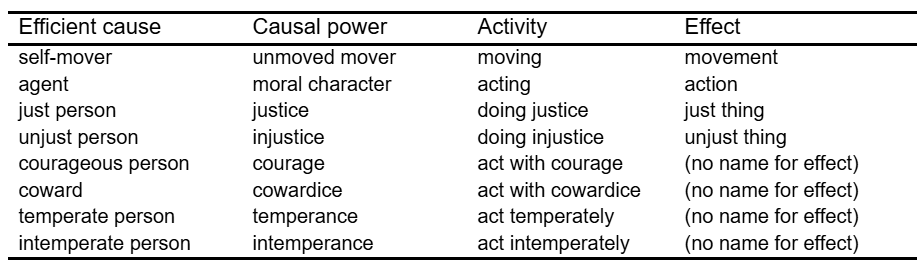
Note: This table is directly replicated from Aristotle on Moral Responsibility by Susan Sauvé Meyer, published in 1993 by Oxford University (p. 153-154).
TABLE DESCRIPTION: Table 1.0 illustrates Aristotle's concept of efficient causation as it relates to moral responsibility. The table demonstrates a consistent causal structure in which an efficient cause (the agent or person), through a causal power (a virtue or vice embodied in moral character), performs an activity (acting in accordance with that character), which produces a corresponding effect (the resulting action or state). Beginning with the general model of the self-mover producing movement, the table applies this framework to moral agency by showing that a person's moral character is the internal cause of voluntary action. It then provides examples of virtuous and vicious agents—such as the just and unjust person, the courageous person and coward, and the temperate and intemperate person—to illustrate how enduring character traits give rise to actions consistent with those traits. While only justice and injustice have named effects ("just thing" and "unjust thing"), the same causal relationship is shown to apply across all virtues and vices. Overall, the table emphasizes Aristotle's view that individuals are morally responsible because their actions originate from their own stable dispositions of character.
Table 2.0
Autism spectrum disorder: DSM-V diagnostic criteria
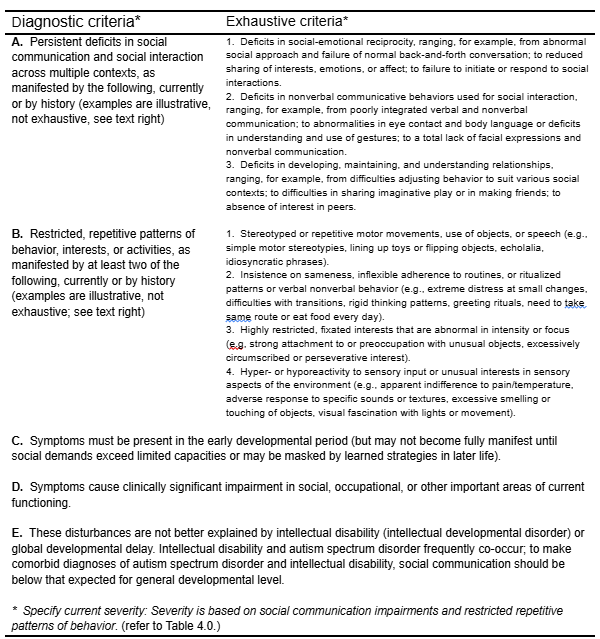
Note: The information on this table is directly replicated into a table format from the DSM-V as listed on Autism Speaks Inc.’s website. (Autism Speaks Inc., n.d).
TABLE DESCRIPTION: Table 2.0 presents the DSM-5 diagnostic criteria for Autism Spectrum Disorder (ASD). The table outlines the five diagnostic requirements (Criteria A–E) that clinicians use to diagnose ASD. Criterion A requires persistent deficits in social communication and social interaction across multiple contexts, including difficulties with social-emotional reciprocity, nonverbal communication, and developing and maintaining relationships. Criterion B requires the presence of at least two types of restricted and repetitive behaviors, interests, or activities, such as repetitive movements or speech, insistence on routines, highly restricted interests, and atypical responses to sensory stimuli. Criteria C–E specify that symptoms must be present during early development, cause clinically significant impairment in daily functioning, and cannot be better explained by intellectual disability or global developmental delay alone. The table also notes that ASD severity should be specified based on impairments in social communication and restricted, repetitive behaviors, and that the criteria are reproduced directly from the Diagnostic and Statistical Manual of Mental Disorders, Fifth Edition (DSM-5) via Autism Speaks.
Table 3.0
Social (Pragmatic) Communication Disorder: DSM-V diagnostic criteria
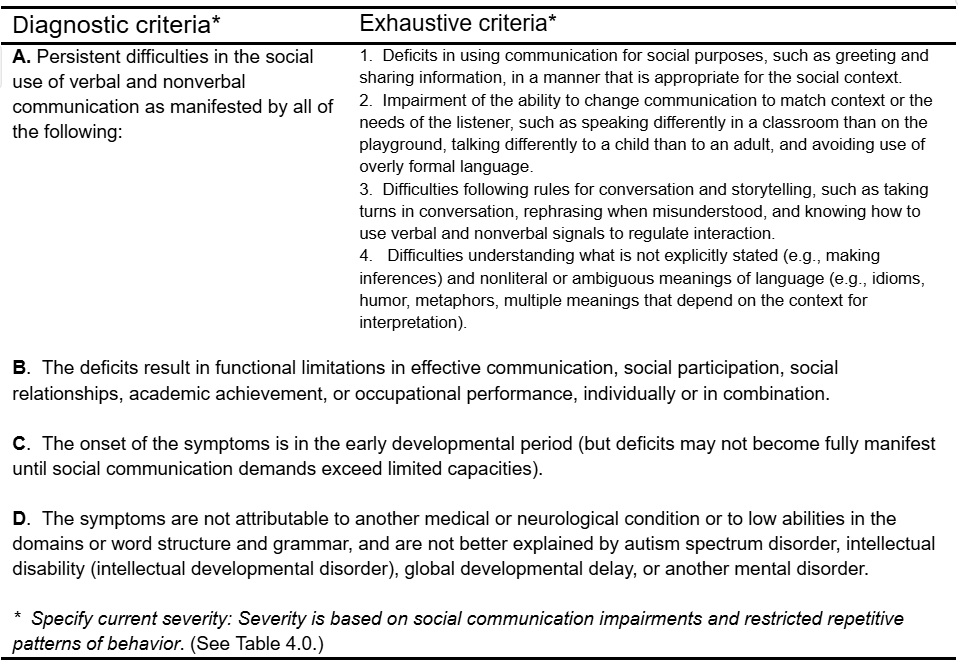
Note: The information on this table is directly replicated into a table format from the DSM-V as listed on Autism Speaks Inc.’s website. (Autism Speaks Inc., n.d.).
TABLE DESCRIPTION: Table 3.0 presents the DSM-5 diagnostic criteria for Social (Pragmatic) Communication Disorder (SCD). The table outlines the four diagnostic criteria (A–D) required for an SCD diagnosis. Criterion A requires persistent difficulties in the social use of verbal and nonverbal communication, including challenges with using language appropriately in social contexts, adapting communication to different listeners or situations, following conversational rules, and understanding implied or nonliteral language such as idioms, humor, and metaphors. Criterion B specifies that these communication deficits must result in clinically significant impairments in social participation, relationships, academic achievement, occupational performance, or other areas of functioning. Criterion C requires that symptoms emerge during the early developmental period, although they may become more apparent as social communication demands increase. Criterion D states that the difficulties cannot be better explained by another medical or neurological condition, language deficits, autism spectrum disorder, intellectual disability, global developmental delay, or another mental disorder. The table also notes that symptom severity should be specified and that the diagnostic criteria are reproduced directly from the Diagnostic and Statistical Manual of Mental Disorders, Fifth Edition (DSM-5) as presented by Autism Speaks.
Table 4.0
Autism spectrum disorder: Severity levels
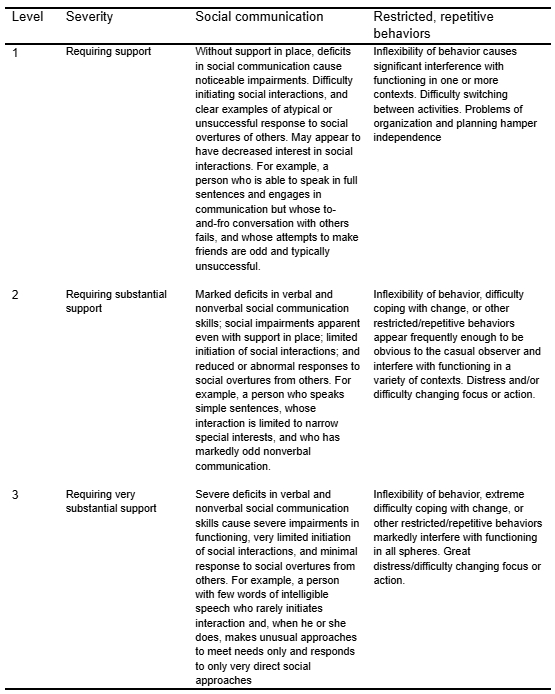
Note: The information on this table is directly replicated into a table format from the DSM-V as listed on Autism Speaks Inc.’s website. (Autism Speaks Inc., n.d).
TABLE DESCRIPTION: Table 4.0 outlines the DSM-5 severity levels for Autism Spectrum Disorder (ASD), which are used to indicate the degree of support an individual requires in two core domains: social communication and restricted, repetitive behaviors. The table identifies three levels of severity. Level 1 ("Requiring support") describes individuals whose social communication difficulties are noticeable without support and whose behavioral inflexibility interferes with functioning in one or more settings, although they retain a degree of independence. Level 2 ("Requiring substantial support") is characterized by marked deficits in verbal and nonverbal communication, limited social initiation, and more frequent restricted or repetitive behaviors that significantly disrupt functioning across multiple contexts. Level 3 ("Requiring very substantial support") represents the greatest level of impairment, with severe deficits in social communication, minimal initiation of social interaction, and extreme behavioral inflexibility that substantially interferes with functioning in nearly all aspects of daily life. Overall, the table demonstrates that ASD severity is determined by the intensity of impairments in social communication and restricted, repetitive behaviors, with increasing levels corresponding to progressively greater support needs.
Table 5.0
Examples of sensory processing problems someone with ASD might experience
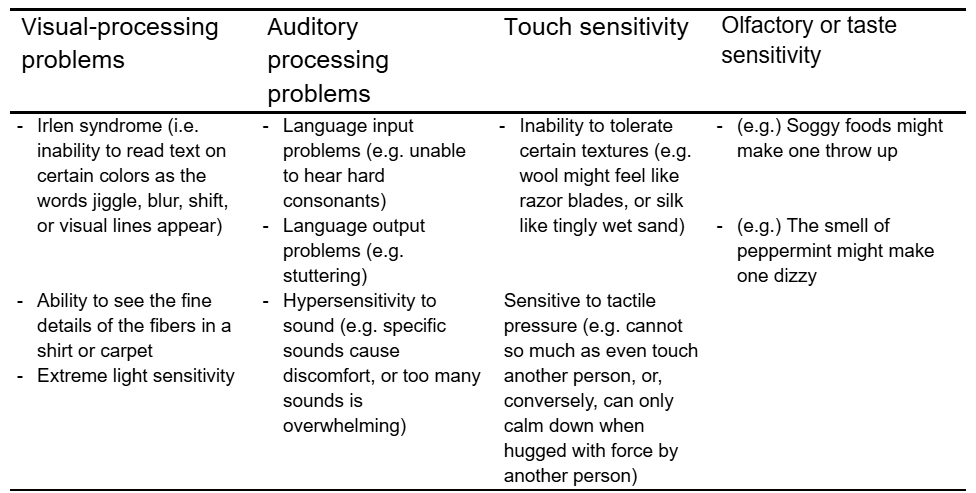
Note: This table adapted partially from examples provided in The Autistic Brain: Helping Different Kinds of Minds Succeed by Temple Grandin, published in 2013 by Mariner Books (p. 87-98).
TABLE DESCRIPTION: Table 5.0 provides examples of the diverse sensory processing differences commonly experienced by individuals with Autism Spectrum Disorder (ASD). The table organizes these differences into four sensory domains: visual processing, auditory processing, touch sensitivity, and olfactory or taste sensitivity. Within each category, it illustrates how atypical sensory processing can affect everyday functioning. Visual processing examples include Irlen syndrome, extreme light sensitivity, and heightened perception of fine visual details. Auditory processing examples include difficulties processing spoken language, speech production challenges such as stuttering, and hypersensitivity to sounds that may become overwhelming or distressing. Tactile sensitivities range from intense discomfort with certain clothing textures or physical contact to a need for deep pressure to achieve a calming effect. Olfactory and taste sensitivities include strong adverse reactions to particular smells or food textures, such as dizziness triggered by peppermint or nausea caused by soggy foods. Adapted in part from Temple Grandin's The Autistic Brain, the table highlights the wide variability of sensory experiences among individuals with ASD and underscores the importance of recognizing sensory processing differences as a significant aspect of the condition.
Figures
Figure 1.0
Aristotle’s theory of moral responsibility: A flow chart
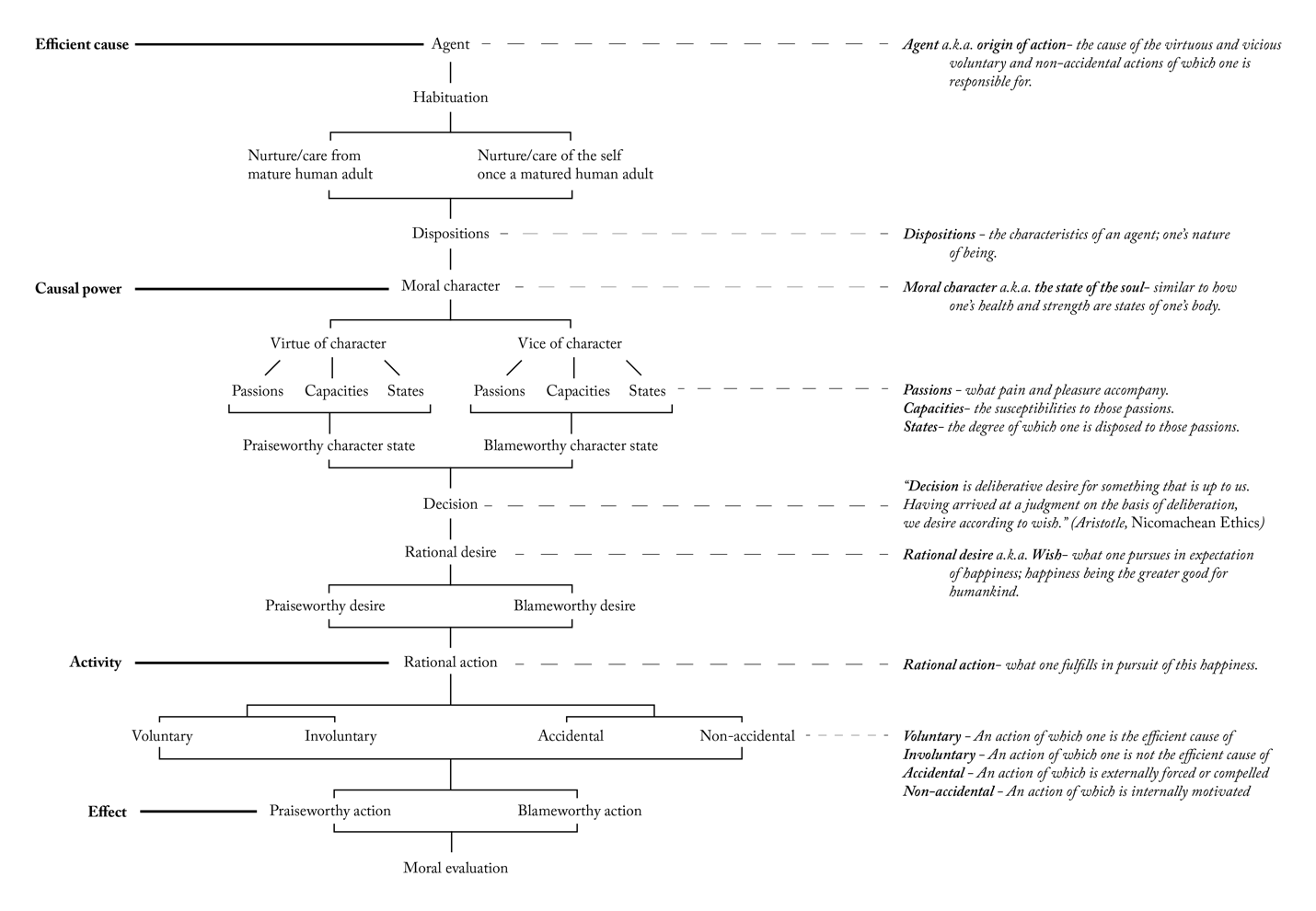
IMAGE DESCRIPTION: Figure 1.0 illustrates Aristotle's theory of moral responsibility through the framework of efficient causation. The flowchart traces how an agent, as the origin of action, develops moral character through habituation, first under the guidance of mature caregivers and later through self-directed cultivation. Habituation forms enduring dispositions, which become either virtues or vices of character, shaping an individual's passions, capacities, and stable character states. The figure shows that moral character influences decision and rational desire, which lead to rational action. Actions are classified as voluntary or involuntary and accidental or non-accidental, ultimately resulting in praiseworthy or blameworthy actions that are subject to moral evaluation. Explanatory notes define key Aristotelian concepts, emphasizing that moral responsibility arises from actions that originate in an individual's developed character and deliberate choice.
Figure 2.0
Moral reasoning in typically developing people and those with autism spectrum disorder
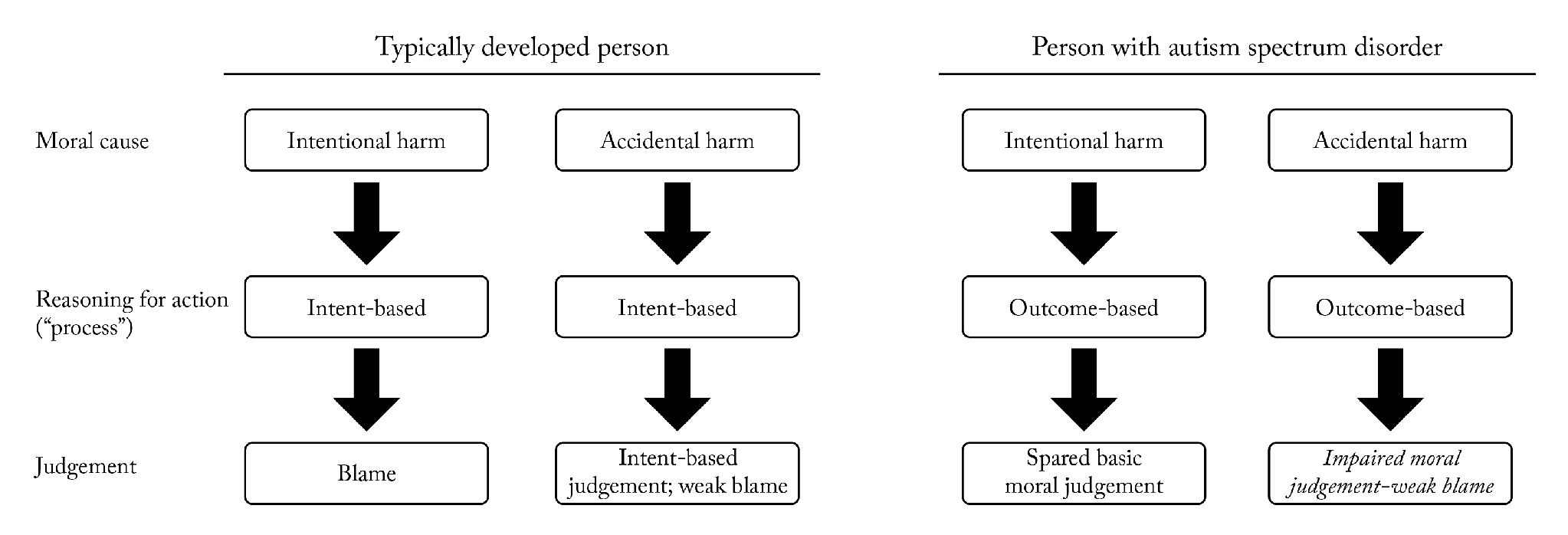
IMAGE DESCRIPTION: Figure 2.0 compares the process of moral judgment in typically developed individuals and individuals with Autism Spectrum Disorder (ASD). The figure contrasts responses to intentional harm and accidental harm, illustrating differences in the reasoning process that leads to moral evaluation. For typically developed individuals, both intentional and accidental harms are evaluated using intent-based reasoning, resulting in blame for intentional harm and only weak blame for accidental harm. In contrast, individuals with ASD are depicted as relying primarily on outcome-based reasoning, emphasizing the consequences of an action rather than the actor's intentions. As a result, intentional harm may receive a spared or typical basic moral judgment, whereas accidental harm may be associated with impaired moral judgment, leading to greater blame than would typically be assigned. Overall, the figure highlights differences in how intent and outcomes are weighted during moral reasoning, suggesting that individuals with ASD may rely more heavily on outcomes when evaluating morally relevant actions.